


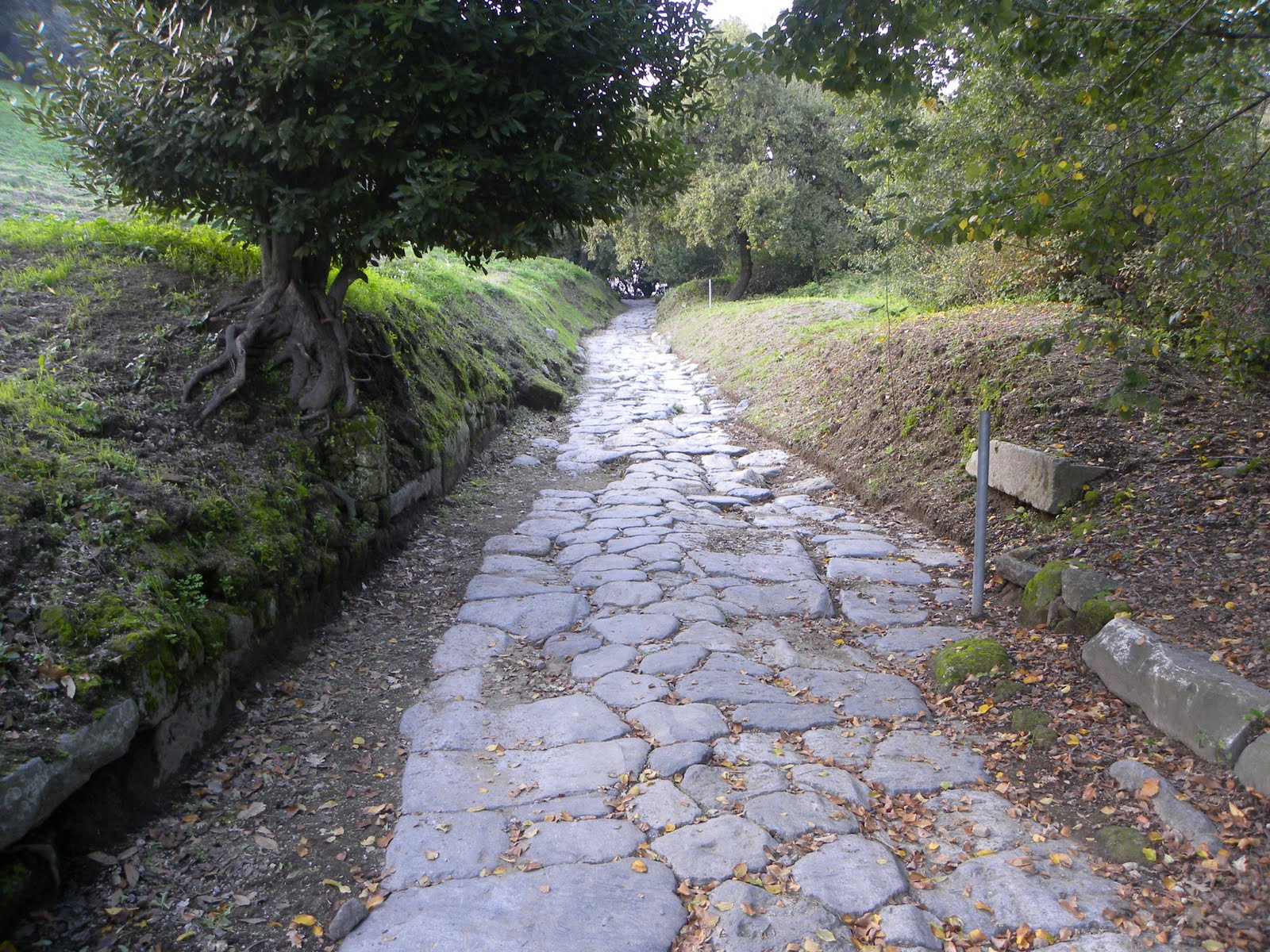

(Pictures: The trapezoidal fortification, the Temple of
Apollo, cobblestone road, the Temple of Zeus.)
Tanto gentile e tanto onesta pare la donna mia...
(So kind and so honest my lady appears to be...)
Dante Alighieri's Sonnet 26 from La Vita Vuova
Nook of Naples: Cuma is the oldest Greek colony in Italy, dating back to the 6th century B.C. From the entrance, visitors walk along a dirt path, under a mammoth hollow stone and reach a trapezoidal fortification with large shafts that pour light into the hall from one side. At the very end of this hall, two stone openings squeak with pigeons. Some say that the Sybil gave her oracles here.
Virgil’s character Aeneas first landed here when he arrived in Italy. Aeneas wanted to consult the Sybil, a woman who very likely by Roman times didn’t exist. But Virgil’s description of this trapezoidal fortification is uncanny. The Romans adored Greek culture and very likely preserved and used this acropolis for their own worship. Archeologists believe that the Sybil didn’t exist here. Instead, the Romans created this trapezoidal fortification for military purposes, connecting the acropolis to Lago Averno.
From the trapezoid structure, steps lead to a panoramic view of the ocean where, if not Aeneas, then Imperial Roman naval ships sailed. Further up, a Temple of Apollo (the same name as given to the temple at Lake Averno) is nothing more than flattened rocks. Another path takes tourists to the Temple of Zeus (or, for the Romans, Jove), which was first a Roman temple and then an early Christina basilica.
Recently restored and opened to the public, the lower city lies outside the entrance gate. Inhabited at a later period than the Cuma acropolis, the city once sat along the water. (Note that now the entire complex is far from the sea.) The ruins display a Samnite age forum, underneath which lies the more ancient agora or Greek city center. A necropolis area can also be viewed. It once extended about 3 km and archeologists have found armor and funerary vases here.
Getting There: Use your GPS and simply type 'Cuma'. It's fairly easy to find. Once you get about 3 miles north of Pozzuoli, you'll see signs everything. The address is: Via Acropoli 39.
Book Recommendation: The Oracle by William J. Broad. This book is about the latest scientific findings concerning the Sibyl and why her trance-like states may have been induced by narcotic-like fumes rising up from the crevices of the earth. Although the book focuses on Delphi in Greece, because these Phlegraean Fields have fumes and fires bubbling just underfoot, the book also feels relevant for Cuma.
La Cucina Neapolitana: We can't be sure if the Sibyl's mutterings were induced by the gods or if some coaxing was necessary through ingesting some mutter-inducing libations. Certainly, the Neapolitans have their share of wine and -- my favorite -- digestifs. Digestifs are drunk after a large meal in order to aid in digestion. The most renown here is Grappa, which comes in many different flavors, but usually is served as a clear grain alcohol. Other digestifs include: Sambuca (a sweet licorice taste), Anice (also with a sweet licorice taste, only stronger in alcohol content), Maraschino (a sweet cherry flavor), and Limoncello (drunk ice-cold with a strong lemony taste). A few spoonfuls of the sweeter digestifs are also often added to espresso. I've seen quite a few men at the coffee bars drinking these topped off espresso drinks around ten in the morning.
Lemons are plentiful in this region and it's not uncommon for families to make homemade Limoncello. Here is a recipe from the Italian cookbook: Cucina Napoletana by Roberta Avallone.
Limoncello
2 pounds lemons
8 cups grain alcohol
8 cups water
1 pound sugar
Peel the lemons making sure not to use the white part. Put the lemon zests into a jar and pour the alcohol over it. Let sit for three days and then filter out the zests. Boil the water and pour in sugar. Stir until the mixture becomes a clear syrup. Stir the syrup into the lemon alcohol. Place the mixture in a bottle and chill in the freezer.
If this recipe makes you utter prescient oracles, please feel free to leave them in the comments section here.
Cin-Cin!


