Thursday, August 27, 2009

The Espresso Break


Caffe:  There's not a Starbucks for miles around.  When you ask for coffee and want something that comes in a cup larger than the length of your thumb, Neapolitans either look confused or smirk.  For them, coffee is caffe and caffe everywhere else in the world is called espresso.

Neapolitans drink three kinds of caffe all day long:  lungo (long, like a double shot), ristretto (short, no more than a tablespoon), and macchiato (long with a dollop of milk foam on top).  What makes a cup of caffe good or bad is the frothy foam on the shot.  The espresso machine and the barista together perfect this art.

In the morning, Neapolitans also drink cappuccino, which is a shot of espresso with milk and foam and comes in a regular tea cup.  But Italians don't tend to drink cappuccino beyond the early morning hours.  They also don't eat breakfast, ordering a quick cornetto (crossaint) instead.  Sometimes you can see men drink caffe with a little "top off" of an aperativo in the morning, such as Martini & Rossi.  Most Italians spend a lengthy time standing at the bar counter stirring sugar into their caffe before downing the shot.

While Italians don't copy Starbucks, nowadays baristas often do add an 'extra touch' to their caffe.  In fact, some of the best caffe renditions come from -- you'll never guess it -- the Caffe Bars at the shopping malls.  

Just about anywhere in the city, you can get specialty coffee drinks with their own exotic names like "The Morocco" or "The Grandma."  They announce their twists on billboards and each bar  considers their speciality drinks proprietary.  

A drink I had recently included amaretto flavoring, whipped cream, chocolate syrup, and a shot of espresso.  The barista encouraged me to stir it before I sipped.  

These beverages are enjoyed at all hours of the day.  Now I'm on the hunt for the best new 'caffe drink' in Naples.  I'll post my findings along the way.

For today, I'll say -- Zing, Zing!


Wednesday, August 26, 2009

A Note From Barbara

Buongiorno!  

I've decided to expand The Espresso Break to include several Tours of Naples.  As I travel in search of the eccentric side of the city, I'll be posting under the following headings:

The Naples Underground Tour:  Naples has over 700 cavities that date back to the 4th century B.C.  I'll be in search of this 'parallel city,' now considered a major part of the study of urban speleology and first re-discovered during the 1970's when firemen were sent to put out a fire and found that Neapolitans were using these cavities to dispose of their trash.  (Every first Thursday of the month.)

The Odious Women Tour:  I've posted already about the ruthless and sexually charged Roman women, Agrippina and Poppea.  I will continue to search for women in the city who were once considered odious, but I'll expand my search through the ages to include trailblazing Renaissance women painters, Jacobin revolutionaries, and saints who lost their lives for heretical beliefs.  (Every second Thursday of the month.)

The Espresso Break:  Neapolitans pride themselves on their coffee.  And I've noticed a new development in the city.  Baristas are now expanding their repetroire to include a bevy of new coffee creations, naming things like 'The Morocco' and 'The grandma'.  I want to roam to as many cafes as possible in search of the these new and eccentric versions of paradiso.  (Every third Thursday of the month.)

Port Call:  Will describe extras and oddities in and around the city as well as describe tours, such as those for kids or following the journey of St. Paul the Apostle.

Other than during 'The Espresso Break' posts, I will continue to include Neapolitan recipes.

Hope you enjoy it.

Un caro abbracio!
Barbara

Sunday, August 23, 2009

Hospital Emergencies

I received the following information from Lynn La Benz.  If you happen to need emergency care while traveling overseas, here is what she found:  

I know we all travel with our passports on the outset of our trip because we need them for customs and checking into our hotel.  However, many of us then pack them back into the suitcase during our stay.  In July, I decided to make a copy of the passport photo page (showing all passport information) for each of my family members, then I cut them down and stuck them into my handbag.  Of course I also packed the regular passports.

This turned out to be a good thing.  When my son needed stitches while we were vacationing in Croatia, at the emergency room and again at the hospital before his stitches, I was asked for both my and his passport.  Normally I wouldn't have had them on me (too heavy) but I did have the copies, which were accepted immediately.

What's more, I found that when you are injured overseas, there is a go-between to help you find your way to the hospital, translate services, and provide authorization for the payment of treatment.  It's called SOS International.  They are London-based and the staff there was friendly, efficient, and helpful.  Although we had to pay about 35 USD for the ER triage, the surgery/stitches were covered by the fax that SOS International sent to the hospital authorizing payment for treatment.

Travel Tips:
1)  Carry either your passport or copies of your passport at all times.
2)  Check the SOS International website to find the plan and health benefits that apply to you.
3)  Keep the relevant numbers in your cell phone and write the information on the back of your passport copies.

For military members, here is the TRICARE Operations information:
(Make sure to click on the link to see more.)

International SOS
London Sixth Floor
Landmark House Hammersmith Bridge Road
London W6 9DP
Tel: +44 (0) 20 8762 8133
Fax:  +44 (0) 20 8762 8125
Email: tricarelon@internationalsos.com

Thank you, Lynn!!!

Thursday, August 20, 2009

Grotto di Pastena


Val più la pratica della grammatica.
(Experience is more important than theory.)

Nook of Naples:  About 85 kilometers north of Naples lies an impressive and yet out of the way Grotto di Pastena.  We plan to go to Formia, but see signs for the Grotto and we're curious.  It's a liesurely Sunday afternoon, so we say to ourselves -- why not?  It's surely close, otherwise why would there be a sign?  

An hour drive later up several mountain roads, we spill into a gravel parking lot replete with a restaurant and souvenir shop.  (Italian roads tend not to have the distance marked on their signs.)

Once we stand at the Grotto entrance and pay the 8 Euro fee per adult, we stroll down a park pathway and reach a rock opening with shades of copper and mossy green.  The Grotto measures 2127 meters long and is actually a huge river cave.  The river drains into the cave from the valley, creating a large sinkhole.  As we walk through the first chamber and up several steps, we can see small blue lakes and water streams.

Stalagmites and stalactites are everywhere to admire.  If you don't remember your fifth grade science class, stalagmites rise from the floor and stalactites hang from the ceiling of caves.  They form through the dripping of mineralized solutions.  In this grotto the stalactites often look like rippling frosting.

We hear the echo of running water throughout the Grotto, along with squeaking bats.  We walk to the edge of sheer cliffs.  At the end of the tour, we come to a cave of impressive stagalmites that go up a hill until dirt meets the rock above.  Bats fly all around.  And a large black mound of bat excrement towers in the middle.  (Ewe.)

What makes this an impressive visit is the drive itself through windy off-roads that climb up lush green mountains.  It's worth the trip if you remember that the ride to the grotto will take some time.

Getting There:  If you go down the A1 either from Rome or from Naples, you will see the signs to the Grotto everywhere.  It's easy to find.

(Pictures:  The steps leading down to the grotto, the walkway, the grotto from the outside, the entrance hut in front of the grotto, two views of the grotto on the inside.)

Thursday, August 13, 2009

Grottoes, Grottoes, Everywhere!


Nooks and More Nooks!

Grottos seem to be everywhere in this region.  The writer Ovid in his Metamorphosis described nymphs, gods, goddesses, and humans bathing in these cool and hollow hiding places.

A grotto is defined as a small cave near water and liable to flood at high tide.  The word comes from the vulgar Latin 'grupta' meaning 'crypt.'  I'm not sure why Italy seems so glutted with grottoes, but perhaps it has to do with the very porous tufo stone that is a hallmark of the region.  Any geologists or speleologists out there to tell me more?

For the nature lover as well as children who prefer to climb and jump rather than visit museums, a "Grotto Tour" of Southern Italy can be very satisfying.  Here's my own travel recommendation.  If you are driving from Rome going South, you will find the following:

Grotto di Pastena (nestled in a beautiful mountain in the region of Lazio.)
Villa di Tiberius (in Sperlonga overlooking the sea and part of the ancient villa ruins of Emperor Tiberius.)
Grotto di Sibilla (at Lago Averno where the Sibyl purportedly gave her oracles.)
Grotto Vecchia (in Naples in the same park where Virgil's remains are buried.)
Grotta di Seiano (in Naples... I'm still trying to find a way to see this grotto.  It's by reservation only and unfortunately, nobody answers the phone.)
The Blue Grotto (on the island of Capri, which I reviewed last week.)
Grotte Dell'angelo di Pertosa (near the Greek ruins of Paestum and apparently geared for children.)
The Emerald Grotto (three miles west of the Amalfi Coast, I've read reviews complaining that this is a rip-off and not as impressive as advertised.)
Grotta Palazzese (a high-class restaurant located inside a grotto, many famous people come here to dine and stay at the expensive hotel.  It's off the Adriatic Coast.)

Nymphs are said to bath in grottos frequently.  If you happen upon one, take pictures and post them here!

Book Recommendation:  Heavenly Caves:  Reflections on the Garden Grotto by Naomi Miller.  This book traces the development of the grotto from antiquity to modern times.

La Cucina Napoletana:  Perhaps my own puritanism has held me back, but slowly the passions and sensualities of the Romans are growing on me.  So finally, I am posting a recipe for -- an ancient aphrodisiac.

Bulbi For Love
(For all young couples and not so young couples)

Apicio writes:  For those who search for the delights of Venus, boil the bulbs in water, then, as also for the rights of a wedding, serve with pine nuts or the juice extracted from ruchetta and sprinkle with pepper.

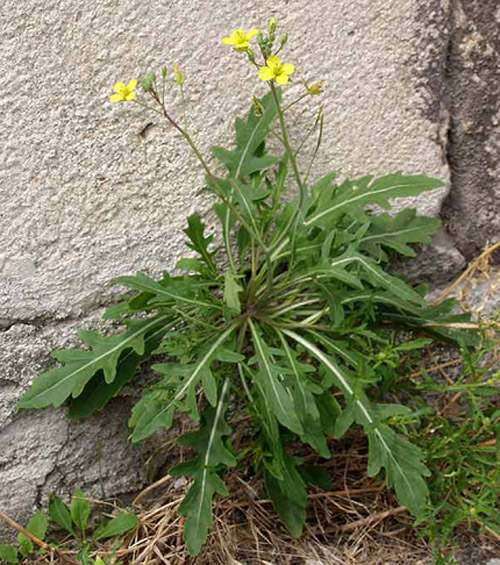
This recipe doesn't need much more explanation.  Ruchetta is still found today everywhere in markets and grocery stores.  I've added a picture of what it looks like.

Bulbi are bulbs very similar to little reddish onions, but very different in taste.  Also known in Italy as 'lampacioni', they are 'lovers bulbs' and in order to eat them, they need to be boiled in salt water, the water changed several times, until they have lost their bitterness.  They are often eaten pickled in the Puglia region.

***Before I published this post I decided to give a shout to other great bloggers on Italy.  I found two wonderful resources.  Bella Baita View in Piedmont told me about Parla Food.  Click on Parla Food to find a picture of lampacioni in Puglia.


(Pictures:  The Blue Grotto, the Grotto di Pastena, the Grotto Vecchia, the Grotto di Sibilla, and the Grotto at the Tiberius Villa.)

Thursday, August 6, 2009

The Blue Grotto


Per anndare d'accordo co il vicino - devi stare con un-occhio aperto e l'altro non serrato.
(To get on with your neighbours - you must go with one eye open and the other not closed.)

Nooks Of Naples:  The island of Capri boasts beaches, amazing vistas, a funicolare that goes to the town center where pedestrian walkways twist along white washed buildings, and the Blue Grotto.  It's a resort island now.  But if you take the 2km walk from the town center to the other end of the island, you also find what remains of Tiberius' villa.  

I already wrote about his summer residence in Sperlonga and his hapless fate with women.  What I left out was that Tiberius exiled himself from Rome and spent the rest of his life in Capri, where he built a large complex and remained until his death.  He left the ruling of Rome to the cruel and ruthless Sejanus.

The two historians who documented Tiberius' life, Tacitus and Suetonius, claim that by the time he lived in Capri, he was a paranoid man who indulged in sexually depraved activities.  He even purportedly had two servants whose names were 'Sphincter' and 'Saddle.'  His subjects in Rome often referred to him as 'Biberius' meaning 'Lush'.  Upon his death at the age of 77, he was denied the usual divine honors of a Caesar and mobs of people in the streets of Rome yelled "To the Tiber with Tiberius."  (At that time, the corpses of criminals were usually disposed of in the Tiber River.)

Today, sheer cliffs and beaches make this island beautiful.  The Blue Grotto is the main tourist attraction, which would be a wonderful experience -- if it wasn't also a rip-off.

We pay a fee at the harbor and a boat takes us along the sheer cliffs until we reach the opening of the grotto.  Here, we're required to pay another 10 Euro (per person) to get into a row boat.  The rower then tells us to lie down in the boat.  He pulls at a chain strung through a small rock opening and the boat rushes inside.  We enter a dank hole -- I mean a cave -- where ambient blue light shines from the bottom of the water on one side.  The rower sings a song from the Spanish group, 'Gypsy Kings,' his voice echoing throughout the cave along with the many other rowers.  When we leave the grotto, the rower asks for an additional tip... and then asks for an additional tip to the one we just gave him.  All in all, the experience leaves us with a Tiberius-like sense of fiduciary perversity.  (I'm sorry, but it does.)

Getting There:  You can catch the ferry to Capri almost once every hour of everyday at the port in downtown Naples.  For more information, the Capri tourist website is excellent.

La Cucina Napoletana:  Capri cuisine has its own particular flare.  Some of the more well-known dishes include stuffed calamari, wild quail, capri style ravioli, and caprese cake made from chocolate and almonds.  The island also makes its own wine "Capri Bianco".

But for today, I'd like to continue on my ancient Roman recipes... and for two more posts.  After that, I'll have translated enough recipes to create a several-course meal of ancient dishes.  And I've found something simple that's also perfect for these sweltering Italian summer days of August.

Omelette Al Latte
(A New Type of 'Sugar Omelette')

Apicio writes:  Four eggs, a half liter of milk, 25 grams of oil, all well combined.  Put a bit of the oil in a thin frying pan, make hot, then add the prepared mixture.  When one part is cooked, turn it over, put on a tray, drizzle with honey, dust with pepper and serve.

(This recipes makes enough for 4 people)
4 eggs
2 cups milk
1 tablespoon oil
generous amounts of honey
generous amounts of pepper

Take the eggs, milk, and oil and combine together.  Put a little oil into a frying pan for omelettes and heat.  Then pour in the eggs with milk.  Let it thicken and when it reaches the necessary consistency, turn it with the help of a plate and let the other side cook as well.  Slide onto a serving platter.  Douse the omelette with honey and dust with pepper.

(This is another recipe from Ricette Della Cucina Romana A Pompeii by Eugenia Salza Prina Ricotti)

Make sure to eat this dish while on a 'depraved' island.