Thursday, September 24, 2009

Purgatory


PORT CALL!


According to Dante, the Mountain of Purgatory was the only land that existed in the southern hemisphere.  It came into existence because of the displaced rock which resulted when Satan's fall created hell.  Now, I am happy to report that I have found a slice of Purgatory in downtown Naples.  It's not really a place you can stay -- more like something to pass.


Located along a narrow street in the district of Spaccanapoli (the Spanish Quarter) on via Tribunali, the Santa Maria Church of the Souls of Purgatory has a baroque facade and a guady show of skulls and femurs adorned daily with fresh flowers and candles.  


It was erected in the early 1600's by Neapolitan noble families seeking a place for their burial crypts.  Today, the church still has a small underground.  Unfortunately, Purgatory is currently under construction and closed to the public.  There is no estimated time when it will open again.  But the cross street, named Vico Purgatorio Ad Arco, certainly gives a feel of what it might be like to take a walk down purgatory lane.


La Cucina Napoletana:  I'm unclear about the origin of today's dish.  It's not strictly Neapolitan, but tasty and a wonderful quick meal to make at home.


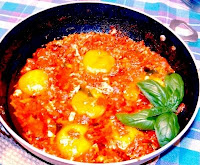
Uova Al Purgatorio
(Eggs of Purgatory)


4 fresh eggs
1 can of diced tomatoes
2 cups of tomato sauce
2 tablespoons of extra virgin olive oil
salt
thyme
1 chili pepper
basil


Heat the oil in a pan until hot and then add sliced chili peppers.  (The dish is meant to be served spicy, but you can add as much or as little as you like.)  Add the can of diced tomatoes and the tomato sauce.  Simmer for 6-7 minutes, stirring here and there.  Add a pinch of salt and thyme.  Crack the eggs into the pan.  Cover and cook for 2-3 minutes or until the eggs turn white.  Serve the eggs hot accompanied by the spicy sauce and garnish with basil leaves.  


Wednesday, September 23, 2009

The Naples Underground -- Today's Disaster


At about 4am this morning, three chasms opened in the historic Spaccanapoli district of downtown Naples.  The largest chasm was about twenty meters deep in the middle of a street considered a major nerve center for traffic.  Six buildings had to be evacuated with 297 people leaving their homes.  Tensions arose among the evacuees who fear remaining homeless without help from any government institutions.  Another chasm also opened beneath a church, putting it at risk of collapse and making its entrance practically disappear.  The newspaper, Il Mattino, suggests that the chasms were provoked by the heavy rains of the last few days.  The mayor, Rosa Iervolino, underlines that a complete picture of the damage and causes will be available after officials complete their investigation.  

To see the article in Italian, click this link to the Neapolitan newspaper Il Mattino.  Or you can view the photographs of the damage.

Saturday, September 19, 2009

The City of Miracles


A Nook of Naples Announcement:  Today, September 19, 2009, San Gennaro's blood liquified -- ushering in a year of good fortune for Neapolitans.  

According to legend,  San Gennaro was born sometime in the third century to a rich patrician family.  At fifteen years of age, he became a priest.  During the persecution of Christians by Emperor Diocletian, San Gennaro was sentence to death for his beliefs and beheaded in Pozzuoli.  His bones and blood were then saved by a woman named Eusebia just after his death.  

Today, his tomb is located underneath the altar of Il Duomo, the city's cathedral located downtown.  In a side niche of the church, San Gennaro's dried blood is stored in two hermetically sealed ampoules (vials) and adorned in a silver reliquary.

Every year on the 19th of September, Naples celebrates the Feast of San Gennaro (the date of his sainthood).  At that time, the solid reddish-brown contents of the ampoule liquify.  The blood doesn't always liquify on command, sometimes taking several hours, or liquifying several days before the celebration, or -- most ominously -- not liquifying at all.

Scientists have tried to study the phenomena, but are not allowed to open the ampoule as Church leaders fear they will damage or ruin the blood.  Hence, scientists have used alternative methods, but have been unable to come up with an adequate explanation for the phenomenon.  Many people note that during the years when San Gennaro's blood has not liquified, bad things have happened to the city and the world.  Others maintain that when they came to mass and witnessed the liquefaction, kissing the reliquary, they were healed of all sorts of ails.

I myself went to see the miracle today and found an aisle seat toward the back just before 9:00 a.m.  The Cardinal held mass, giving a sermon in which, toward the end, he reminded parishoners about the importance of helping the poor of Naples.  Thereafter, he processed to the side altar and took out the reliquary.  

Today, the blood liquified immediately.  Thereafter, the Cardinal processed to the front of the church while the congregation applauded and waved white hankerchiefs.  He processed with the liquefied blood down the middle aisle so that all could see.  He processed outside and announced to the city that the liquefaction had occurred.  Then he returned the blood to the altar.  The reliquary will be left there for the next eight days to show the people of Naples that San Gennaro has yet again blessed the city.

Thereafter, the streets of Naples were closed off for religious processions.  Candies and children's toys were sold on the streets.  Decorations were everywhere and a festive ambience filled the city.

I'd like to thank my host city -- and especially the wonderful old lady who sat next to me and explained much of the celebration -- for letting me take part in this special event.  It was, admittedly, the first time I'd ever witnessed a miracle.

Happy San Gennaro Feast Day!

The Feast of San Gennaro


Pictures:  Inside Il Duomo, the silver bust of San Gennaro, the silver reliquary with the liquified blood, a priest gives confession, candy vendors outside the cathedral.


video

The video displays the Cardinal announcing the liquefaction of San Gennaro's blood.


Thursday, September 17, 2009

The Caffe Morocco


When I ask Italians about the shopping mall (
il centro commerciale), they immediately say they can't stand it.  They prefer to walk an open market where vegetables, seafood, and clothing come at great prices.  They also prefer small shops to chain stores.

And yet, every evening and every weekend the shopping malls in the suburbs of Naples teem with people.  The parking lots are full, people push through crowds outside stores, and the food courts draw families and teenagers to eat at McDonald's or at the chain restaurant Fratelli La Bufala.  You can find movie theaters as well as snazzy chain clothing stores like the Spanish Zara.  The French-owned grocery stores Auchan and Carrefour are versions of Walmart with electronics, music, books, toys, clothes, beauty products, and gourmet foods.

All this glitz has also given rise to excellent caffe.

At the mall in the suburb town of Guigliano, a caffe bar called Lino's Coffee  has an array of proprietary drinks.  The Morocco is my favorite, made with a teaspoon of cocoa powder, a layer of espresso, a layer of flavored chocolate syrup, a layer of milk foam and then -- optionally -- a dollop of whipping cream with or without chocolate powder on top.  Once you get the drink, preferably al banco (or at the bar), you must spend a good amount of time stirring until all the ingredients are mixed together.  Therafter, three or four gulps are enough.

Don't forget to use the water they always give you on the side.  You can ask for either natural or frizzante (carbonated) water.  Drink the water before and after the caffe in order to clean the palette.

Mmmmmm.

Thursday, September 10, 2009

The Odious Women Tour


An Odious Woman:  A female who does more than remain in the home to serve her family as cook and housekeeper.

I have already described the lives of several odious women, including Poppea (the ambitious wife of Nero whom he kicked to death while in a rage), Agrippina (the sexually exploitative mother of Nero whom he tried to kill several times before he succeeded), and the Sibyl (who uttered her oracles in dank trapezoidal fortifications).  Whenever I make a sharp left or drive down a one-way street, the lives of Neapolitan women seem to either jump out or hide in cavernous corners.  So I've decided to visit this region with a new bent -- finding the odious women who played a significant role in shaping Neapolitan history.  The tour includes:
  • Sophia Loren -- A native of Pozzuoli whose traumatic childhood provided grist for her sexy roles.
  • Eleonora -- Active in the literary salons of Naples during the 18th century, the Bourbons executed her for being a Jacobin.
  • Artemisia Gentileschi -- Raped at a young age by her father's friend, she was the only female Renaissance painter and spent many impecunious years in Naples.
  • Fiammetta -- The woman who caught the eye of Boccacio while in Naples.
  • Saint Restituta -- One of the North African martyrs, she was placed on a blazing boat and set to sail.  Nevertheless, she survived the grisly ordeal.
  • Santa Patricia -- A descendant of Constantine the Great, she is the patron saintess of Naples and her blood liquifies every Tuesday after the 9:30am mass at San Gregorio Armeno church.
  • The prostitutes of Pompeii -- From the brothel in Pompeii to the secret cabinet at the National Archeological Museum, who can forget that the sensuous culture of Italy stems back to these ladies?
  • The Paestum Women -- This ancient city holds the treasures not of one, but of many women.  Not only did the people of Paestum venerate two female goddesses, Hera and Athena, but the homes and markets here were once filled with the rich heterogeneity of women's images and experiences, including those of the hetaera or courtesans.
If you have any other women you'd like me to find in Naples, please post them in the comment section.  I will be tracing the histories of these women during these next few months.

La Cucina Napoletana:  What goes well with Odious women?  I say -- Neapolitan desserts.  During this tour, I will include the luscious desserts from this area.  Today, I keep it simple.  Neapolitans eat an abundance of fruits.  Watermelons abound throughout the month of August.  I've also often seen hanging kiwi gardens.


No recipe necessary.  Eat using plates, forks, and knives -- or not.

Sunday, September 6, 2009

Ciao Amalfi


Writer, architecture buff, and lover of Italy -- Laura Thayer has featured my blog on 'Ciao Amalfi '.  Check it out and then read the rest of her blog for the wonderful sights and delights of the Amalfi Coast.


Buona Domenica!

Thursday, September 3, 2009

The Tale of the Underground City


Naples is really a tale of two cities.  One, the narrow streets with seemingly no logic and bustling traffic.  The other, more than 3,000 years old that curves, collapses, and hollows underground, made of porous tufo stone.  Sixty percent of the population lives over more than 700 cavities of the city.  These subterranean passageways include old Roman markets, theaters, grottos, crypts, and more.  Most of these cavities remain closed or barely discovered.

Interest in this underground world surfaced in 1979 when a woodworker -- using an old well shaft in his shop to dump wood shavings, sawdust and other material -- made a paper torch to look down into the shaft.  He dropped the torch inside and the fire not only burned the refuse below, but spread throughout an entire city quarter, releasing acrid and noxious fumes. Thirty families were evacuated and firemen along with volunteers searched the extensive underground maze for more than two weeks until they were able to extinguish the fire completely.

Thereafter, stories abounded about this parallel city.  Mob clans purportedly created drug labs in underground caverns near the Naples central train station.  An older couple living in a Naples apartment went to sleep one night and suddenly their entire bedroom plunged almost thirty feet into a void beneath their home.  Some say that these unexplored cavities mean Neapolitans live with imminent danger of all kinds.

These caverns and passageways are also fun for visiting.  

In the middle of the city, the Napoli Sotterranea provides daily tours in English.  Across the street, you can visit St. Lorenzo Maggiore, an old Roman market that you can wander on your own.  On weekend mornings, Caffe Gambrinus offers tours that include air raid shelters and narrow passageways (only in Italian).  Near the Capodimonte Park, you'll find the Catacombs of San Gennaro (patron saint of the city).  If you buy a ticket to these catacombs, you automatically can visit the Catacombs of San Gaudioso where the Dominicans used the skulls and spines of people to decorate the underground cemetery.  I will be visiting these places and report on them each month.

The underground places I've already written about are:  Virgil's Tomb in the Mergellina district outside of which is the impressive Grotto Vecchia (a 700 meter tunnel closed to the public).  A little further afield, the The Grotto della Sibilla at Lago Averno is an old Roman tunnel where the sibyl purportedly gave her oracles.  And finally, in the town of Capua about 15 km north of Naples, The Sanctuary of Mithras still preserves an old fresco of Mithras slaying a bull.

Three other underground attractions I'd like to explore, but currently are closed to the public include:  The Fontanelle Underground Cemetery, an underground cave the size of a soccer field where hundreds of human skulls have been preserved.  Pausylipon and the Grotto di Seiano, near the swank Posillip district of Naples, is a long Roman tunnel with a breathtaking view that leads to the ruins of an Imperial Villa.  Piscina Mirabilis is a 96km aqueduct ending in a massive storage reservoir dating back to the Augustan period.  I will be on the look-out for how to visit these three places in hopes of getting a glimpse.

Information for this blog post was in part found at a fantastic website created by Larry Ray.

La Cucina Napoletana:  What kind of food recommendations would go well with the Naples Underground?  Contorni.  The fertile soil -- and whatever else goes on underground -- make vegetables and fruits grow here with reckless abandon.  Gardeners don't even need a green thumb.  And Naples is a paradiso for vegetarians in particular, since the Neapolitans have a bevy of contorni (side vegetable dishes) that can also function as hearty meals.  Today I add my own simple favorite:  

Pepperoni con Caperi
I see peppers sold everywhere in large sacks, usually all three colors together -- red, green, and yellow.  Using a sharp knife, cut, de-seed, and then slice as many peppers as you can eat.  Drop them in a hot frying pan along with one or two tablespoons of olive oil.  Fry them up for three to five minutes.  Next, add two teaspoons of salted capers.  Stir and serve as a snack or alongside several other vegetable dishes.

Growing Tip:  If you happen to be an underground gardener, you'll be happy to know that you never need to water your plants thanks to the year-round humidity.  (You might, however, need to provide twenty-four hour sunshine to create the photosynthesis.)

Wednesday, September 2, 2009

Speleology


Speleology:  the scientific study of caves, their structure, physical properties, history, life forms and the processes by which they form (speleogenesis) and change over time (speleomorphology).  The term is also used for the recreational activity of exploring caves, also more commonly known as caving, spelunking, or potholing.


I've already written a lot about the grottoes in and around Naples.  Even more fascinating are the 700+ cavities under the city, most of which remain unexplored.  But since the 1970's a large number of novices and experts alike have made urban speleology a popular study in Naples.  Tomorrow I'll start my tour of this parallel city.  For any aspiring speleologists, here is a link to more information in English about urban speleology in Naples .


Happy spelunking!