Friday, April 30, 2010

The Bourbon Tour

The legacy of Bourbon rule (1734-1798) can be seen through their dazzling buildings. Today, I'd like to give a visual tour of their reign.

In 1734, Don Carlos of Bourbon took over rule from the Austrians and was crowned King Charles of Naples. His first stop was to pay homage to the remains of Saint Gennaro, the patron saint of the city, whose blood liquefied immediately. The Bourbons, thereafter, reversed two centuries of Spanish colonial oppression by initiating civic Enlightenment ideals.

Herculaneum and Pompeii were discovered during King Charles' rule. Well-known artists also visited the city during this era, including Rousseau and Goethe. But the stunning mark King Charles left on the city was architectural in nature.

The Teatro San Carlo turned Naples into an epicenter of musical genius. Castrati such as Farinelli sang here and Rossini (The Barber of Seville) worked here:

King Charles built the Royal Palace of Capodimonte, which today houses some of the finest artwork in the city, including two Artemisia Gentileschi paintings and an Andy Warhol picture of Mt. Vesuvius:
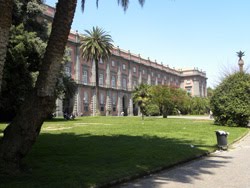


The Royal Palace of Caserta marked the pinnacle of architect Luigi Vanvitelli's career. Located about 15 miles north of Naples, the palace models Versailles, especially with its opulent gardens:


This was also a time mysticism and science gained prominence, as seen through the artwork commissioned by alchemist, scientist, and nobelman Raimondo Di Sangro in the San Severo Chapel. Guiseppe Sanmartino scuplted the Veiled Christ in this chapel.

In 1759, King Charles abruptly abdicated and left eight-year-old Ferdinand in charge. Ferdinand's reign was one of the longest in European history. He was beloved for his Neapolitan dialect and known for setting up a small stand each evening in the market to give away his hunted game or catch of the day. He also established the lottery and a silk factory meant to become an industrial social utopia. Ultimately, the project failed, but San Leucio, near the Caserta Royal Palace, still exists:


The Parthenopean Republic in 1799 brought the Bourbon reign to an abrupt pause. But it failed within a year and Neapolean's French troops entered the city. A husband of Napolean's sister, Joseph Murat, took over. During his fifteen years of rule -- before Napolean's defeat and Murat's own execution by firing squad -- he commissioned the Piazza Plebiscito adjacent to the Royal Palace:


King Ferdinand returned to the throne in 1815. He ruled until his death in 1859. Two years later, the Kingdom of Naples came to an end and the city unified with the rest of Italy.

Book Recommendation: The best English language history of Naples is -- In The Shadows of Vesuvius: A Cultural History of Naples by Jordan Lancaster. If you love Naples, you'll enjoy reading this more than once.

Sunday, April 25, 2010

The Glove Factory


The Sunday Hop: On the top floor of an eighteenth century palazzo, Mauro S. runs an internationally renown glove business. Fifty years ago, small glove shops filled the Sanita district in downtown Naples, but the local mafia as well as large manufacturers from China and the Philippines drove most of them to close. Mauro, on the other hand, took over his family business that has existed for over one hundred years. Proud of his company's long heritage, a photo of his grandparents hangs on a wall of his office.

Mauro S.

Today, Mauro distributes his gloves internationally, including to France, Germany, and the United States. Many of his gloves have appeared in magazines and the President of Italy even visited his company, writing him a thank you letter. What's the secret to Mauro's success? Every one of his gloves are handmade by expert craftsmen. His employees still use the non-electric Singer sewing machines, they cut the leather by hand, and use natural light to distinguish color shades.

Mauro buys his leather from several Middle Eastern countries through intermediaries. From there, the leather goes to a company outside Naples that separates the skin from the wool in large vats filled with water and calcium. The skin goes into a tanning machine, which heats the material for several hours along with vegetable oil and chrome. The leather is then dyed various colors.

Mauro takes this prepared leather to make his gloves. Fifteen people work at the top floor of his palazzo. First, the leather is stretched, being careful to make sure the stretch of the leather will be verticle rather than horizontal. The material is then carefully cut and pounded so that the impression for the fingers becomes clear.

The Cutter

At this point, Maura has about fifty different elderly women throughout the city who receive the cut leather and sew the gloves together. Many of these women once worked for the glove shops and now continue their craft from home. They return the gloves to Mauro, who gives it to his employees inside the palazzo. They use scraps of leather from the cutting room to fill in the gaps between the fingers. One of these women has worked in Mauro's company since she was eighteen -- she is now 78:

The gloves then go on to be lined with cashmere, silk, or other materials. The woman below uses glue to press the lining into the leather. Mauro explains that the only difference between the way he makes gloves and the way his grandfather made them is that his grandfather used one stitch to marry the lining and the leather together, but Mauro uses glue.

Lining the Gloves

The lining and leather are then sewn together at the cuff -- usually carried out once again to the elderly ladies in the city. The gloves often come and go from this palazzo twenty-four times before they are ready.

At the very end of the process, every glove is put on a hot broiler that looks like a metal hand. Then it's placed between two slabs of marble for several hours in order to make it flat. Mauro checks every glove individually before it's ready to be sent to stores.

The Last Step: Heating & Flattening With Marble

Grazie mille, Mauro e cari amici!

Getting There: Mauro gives tours by appointment. He loves what he does and so do his skilled employees.
You can find him at: Omega, srl
Via Stella, 12 -- 80137 Napoli.
Tel: 081 299041
email: omegant@tin.it

Thursday, April 22, 2010

The Lost Remains of Queen Joanna I


The Odious Women Tour: Purported nymphomaniac and brothel owner, Queen Joanna I (1328-1382) was orphaned at the age of five and married at the age of seven. She lived most of her life at the Castel Nuovo. Very likely one of her best memories was when her grandfather, King Robert the Wise, in 1341 publicly tested Petrarch's knowledge for three days straight, after which he granted him the title of Poet Laureat.

Joanna was crowned queen at the age of sixteen. Two years later, unknown bandits murdered her cousin-husband, Andrew, at the royal court's summer castle in Aversa. Joanna was six months pregnant. Andrew's brother -- Louis, King of Hungary -- took advantage of Joanna's vulnerability and invaded Naples. Without a comparable army, the Queen finally fled to Provence, France, but fearing her son wouldn't make the trip, she left him with some of her staff at the Castle dell’Ovo.

Louis of Hungary then entered the city, but Neapolitans revolted. They built fortifications out of cobblestone streets and threw rocks at his army, beating them back. The protests remained so fierce that Louis one night disappeared on a boat back to Hungary. He took with him Joanna's toddler son, who died on the trip back.

Presumably, while in France she opened a brothel in Avignon used by the nobility of Europe. But once Louis had gone, Joanna returned to Naples and married the son of the empress of Constantinople, Louis of Tarant. The Pope who married them observed the wishes of Robert the Wise and granted power only to Joanna. This infuriated her new husband and their relationship quickly devolved into political rivalry. Privately, it was said that Louis spoke to her in lowly terms and even beat her. Nevertheless, she became pregnant with his child and gave birth to a girl, Catherine -- but she died. A wave of Black Death in Naples then took the life of her husband.

With many suitors constantly courting her, Joanna felt her most prudent course was to re-marry quickly. With permission from the Pope, she betrothed James III of Majorca. Seemingly a grand warrior, he’d spent twelve years in prison and soon the Queen realized he was also unsound of mind. In a letter to the Pope, Joanna recounted how in front of all her counselors James III had beaten her and called her a whore. He maintained that she slept with other younger men. And indeed, this rumor seemed to stick and heighten. Several chroniclers claimed she was a nymphomaniac. Nancy Gladstone, her biographer, says slurs were easy to launch against a woman, but highly unlikely given that Joanna had a strong Catholic practice and faith.

In spite of her matrimonial problems with James, the Queen became pregnant at the age of 39 and was excited about an heir. But she lost the baby through miscarriage. Three years later, James III also died.

At the age of forty-two Joanna had to find another husband. She settled on the lesser-known Otto von Brusnwick, a German man a few years her senior and an excellent warrior who would defend her realm without seeking the rights of ruling as king. The couple may have been happy for a time.

But political intrigue brought them both down. When Urban VI, a Neapolitan, became Pope, he enraged cardinals in Rome with his cruel and irrational behavior. The moment the Pope lowered the number of meals for cardinals to one per day, half of them launched a 'great schism'. They elected their own Pope, Clement VI (of French origin), and claimed Urban VI had been unlawfully elected.

Historically, the Vatican and the Kingdom of Naples were closely tied together, so Joanna had a difficult decision to make. Rude and abrasive, Urban VI had already written letters to the Queen saying that a woman shouldn’t rule and that she should lock herself in a nunnery. He also refused to commute her annual tribute which Joanna said she couldn’t pay it because she had sent military reinforcements to the Pope the year before. All this meant that Joanna decided to support Clement.

In reaction, Urban excommunicated her. Worse yet, when the people of Naples found out their Queen had acknowledged a French Pope, they rebelled. Mass protests took place outside her Castle Nuovo and Joanna became locked inside with dwindling provisions. The Hungarians took advantage of the situation and invaded. Although her husband launched a battle, he was captured and imprisoned. Forced to surrender, the Hungarians took Joanna to the Castle Muro and held her in isolation. There, four men came upon her either in her chapel or in her bedroom and strangled her. Her remains were then dumped in the wall somewhere in the Santa Chiara Convent.


Queen Joanna's excommunication remains in effect today. If you visit Santa Chiara to ask about Joanna's remains, most likely you will be given blank looks. But a few aficianados will come to your aide, showing you stairs that lead to a locked door. Some say, Joanna lies somewhere behind them.


(Shown Above: The entrance to the Santa Chiara convent. The hallway that leads to steps. The steps lead to a locked glass door. Inside the door is another smaller door with frescoes all around it. Is Joanna inside here?)

Recommended Reading: The Lady Queen: The Notorious Reign of Joanna I, Queen of Naples, Jerusalem, and Sicily by Nancy Gladstone. (2009)


Sunday, April 18, 2010

The Greek Temples at Paestum


The Sunday Skip: Known during ancient times for its abundant roses, the magnificent ruins at Paestum lie one and a half hours south of Naples.

Rivaling the Acropolis in Athens, the city dates back to 600 B.C. when it was part of Magna Graecia and the Greeks called it Poseidonia (god of the sea).

In 273 B.C. the city became a Roman colony and was renamed Paestum. At that time, the city had some prominence since it sat on a major trade route leading to Rome. But people abandoned it during medieval times, leaving the ruins of the city untouched.

Today, you can visit three well-preserved temples. The oldest, called "The Basilica", was built about 550 B.C. for Hera (the goddess of fertility and motherhood):

The Temple of Poseidon (the Roman name Neptune) was built in 450 B.C. around the same time as the Parthenon in Athens:

The Temple of Ceres was built in 500 B.C and lies at the far end of the ruins. Archeologists believe this temple was misnamed, actually dedicated to Athena (the Roman Minerva), goddess of wisdom and arts:

Along with the temples, Paestum is several cities layered one on top of the other. The amphitheater, for example is of Roman origin (1st century A.D.) and was used for gladiator fights:

The gymnasium was built during the 2nd century B.C., replete with a mammoth swimming pool:

The Museum holds many stunning artefacts, including the 'Metope with Dancing Girls' (6th century B.C.) and the 'Weeping women' fresco from the Lucan tomb:


Getting There: An easy day-trip from Naples, drive along the A3 freeway, take the Battipaglia exit (if you're coming from the North) or the Eboli exit (if you're coming from the South). Follow the 18 highway and take the Paestum exit. You can also follow these Mapquest instructions from the Naples area.

Wednesday, April 14, 2010

Caffe Tiramisu


The Espresso Break: At Caffetteria dell'Arte Antica, located in the historic center of Naples, the cafe has turned the delectable dessert, Tiramisu, into a beverage.

Here, the barista coats a martini glass with thick lines of Tiramisu syrup squirted from a bottle:

He adds some chopped nuts, then pours a healthy shot of espresso into the glass. He sprays a large helping of whipping cream up to the rim. Cacao and more nuts sprinkle the top.

A rich beverage, it's still liquidy enough to drink as a sip-and-go at the counter.

Everything you ever wanted in a drink and a dessert!

Sunday, April 11, 2010

The Artist's Cellar: Brecht in Berlin


The Sunday Jump: German playwright, Bertold Brecht (1898 - 1956), loved women, experimental art, and Marxism.

He escaped military service during WWI after his father suggested he sign up for a medical class at the university. By 1939, when Germany invaded Poland, Brecht left his country and began to write what became more than nine political plays against fascism and Nazi Germany. His wife, Helene Weigel, who was an accomplished actress, played the leading role in his famous Mother Courage and Her Children.

For a few years, Brecht lived in Los Angeles until the House Un-American Activities Committee subpoenaed him. While he admitted that he'd never officially held Communist party membership, the day after his hearing he left to Switzerland.

Two years later, the Communist East German government invited him to return to Berlin and Brecht agreed. His days of writing plays eclipsed and instead he directed plays for the stage. The East Germans sought to make him their own hero, awarding him the Stalin Peace Prize in 1954. He died of a heart attack in 1958 and his wife carried on his legacy, leading the Berliner Ensemble until her death in 1971.

Today, the Keller Restaurant pays tribute to these two layered artists. Located in the cellar of the house where Bertold and Helene once invited friends for nights of carousing, it is said that Helen enjoyed cooking. The restaurant touts a menu based on Helene's signature German and Austrian dishes, including:
  • grilled knuckle of pork with fresh horseradish and white radish salad warm cabbage salad
  • cheese soup with garlic croutons
  • wiener schnitzel with mushrooms and cucumber salad
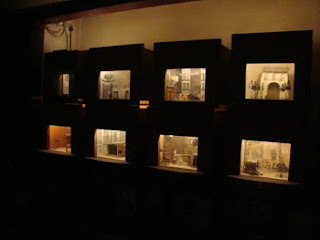
The restaurant also displays lighted dioramas along the walls, which depict the stage settings from Brecht's plays:

Today, their graves sit beside one another in the cemetery adajcent to the restaurant.

125 Chausseestrasse
10115 Berlin

Thursday, April 8, 2010

Purgatory is now open!


The Underground Tour: The Santa Maria delle Anime del Purgatorio ad Arco (Santa Maria Church of the Souls of Purgatory) has re-opened and its underground can be visited by guided tour each Saturday morning.

Neapolitan noble families commissioned construction of this church in the early 1600's so that they could bury their loved ones in crypts under the city.

Stairs in the back of the church descend to an underground cathedral, now hollow tufo stone with niches on either side.

Across the cathedral, a doorway leads to a hallway where rectangular holes display skulls and bones.


From here, the visitor enters a cavern that has two long beds of dirt on either side. Looking closer, these are unmarked graves. Niches in the walls display more skulls and bones, sometimes with small pictures of the deceased next to them.

Up at the front of the room, an altar burgeons with flowers, rosaries, and other memorabilia left by devotees. To the right of the altar, sickly-sweet smelling flowers and handwritten cards sit underneath the remains of Lucia, the virgin-bride. Legend has it -- and many different versions of the legend exist -- that Lucia was the only daughter of Domenico d'Amore, the prince of Ruffano. In 1789, at the age of seventeen, she died of consumption shortly before she was to wed the Marquee Giacomo Santomango. The tragedy caused a tumult of heartfelt emotion by the populous who up until this day still leave fresh flowers and cards underneath her skull and bones.

Getting There: Via Tribunali 39, 80138 Naples tel: 081-5519547
The church is open Monday - Saturday from 10am-1pm, but the underground tour takes place only Saturdays. You should get there at 10am for a tour, although they might make you wait until more people show up. (In truth, the time of the tour varies according to what's happening at that moment.) The cost is 2 Euro.