A Note On International Travel: I'm back in Naples and ready to begin exploring the city once more. But along this Eurailing route, I've used some valuable travel tips which have kept us healthy throughout. So for those interested, here are a few things I'd recommend while traveling in Europe:
1) Eat the yogurt. Everywhere we've gone, we've made sure to eat a little of the local yogurt everyday. Yogurt is probiotic, which means that it promotes the growth of healthy bacteria in the digestive system, taking over and beating back any bad bacteria that can cause illness during a trip.
2) Drink Coca-Cola. Tummy aches are common on the road. A little Coca-Cola during the day settles the stomach. Countries cultivate their vegetables and meats differently, so this beverage helps soothe any aches. Ginger Ale also works well, but we haven't been able to find it very often.
3) Wear shower shoes. We've taken along flip-flops and used them as shower shoes. When you're walking a lot, it's essential to avoid athlete's foot.
4) Keep a few overthe-counter drugs handy. We always take along a bottle of kids and adult Motrin. I suggest Motrin instead of Tylenol because Tylenol only relieves aches and pains, while Motrin brings down inflammation. For back aches or high fevers, Motrin will knock those out for an entire day. I also take along Claritin (in case of allergies) and Dramamine (in case of motion sickness). Bug spray (it comes in small travel containers) during the summer months is also a good idea for keeping away mosquitoes.
5) Pilfer Toilet Paper. Always, always take toilet paper rolls from bathroom stalls or hotel rooms and stuff them in your bag. They always come in handy, particularly on trains and in public restrooms.
6) Wash Your Hands. Wash your hands any chance you get, especially before eating meals. If there are paper towels, use them to open doors to the public restrooms. The largest number of germs exist on the door handles.
7) Wear bags across your shoulders and wallets in your front pocket. No matter where you are, touists generally are considered targets. People know that you've got more cash in your bag than anyone else in town. Keep your purses criss-crossed along your chest, which makes it harder for people to pull off your shoulder and run with it. Men, carry your wallets in your front pockets.
That's it. Hope it's helpful and please let me know if you have some additional tips!
Tuesday, August 31, 2010


Monday, August 30, 2010
Albania in Photographs
A Few Extra Pictures: I am so enchanted by my trip to Albania, that I'd like to post additional pictures.


Albania doesn't have McDonald's. Instead, Kolonat sells hamburgers and fries. This restaurant is in Tirana.

Man sleeping by the river across from the Taiwan Complex in Tirana

In Vlora we found Albania's version of Kentucky Fried Chicken

Bunkers Along the Albanian Riviera

Albanian Worker atop Castle Lekresi near Saranda

Baked Feta Cheese in Saranda

Blue Eye between Saranda and Gjirokastra with about 13 springs coming together 100 feet deep. Albania has several fresh spring water bottling companies.

American Spy Plane at Gjirokastra's citadel. Forced down in 1957.

Gijorkastra Stone Home with Stone Roofs
Southern Albania
The Espresso Trek: From Vlora we wind through Llogara Pass, a mountain area thick with pine trees that once had many holiday camps. Jimmy recalls that you had to have connections at your work to get the ration cards for vacationing here.
From there, we spill into the Albanian Riviera. What makes this area special, other than its stunning beauty, is that it hasn't been tainted by skyscrapers, hotels, or corporate pollution. The road is newly paved and weaves through the mountains. Stray mules roam atop hills and restaurants jut out from the cliffs.
Jimmy explains that in Albania the North is considered less developed and the South more developed. The two regions have their stereotypes about each other also. Northerners are rougher, while Southerners are easy-going. We stop in the Greek Riviera town of Himara for swimming and a seafood lunch. Here, signs display in both Greek and Albanian.

A little further along, tucked at the bottom of a mountain, we also visit the Palermo Castle where another of Albania's heroes -- Ali Pasha -- lived. He built castles throughout the region and consolidated his personal power during the 18th century, stretching to the Greek area of Ioannina. Threatened by his power, the Ottomans eventually beheaded him.

Near the Palermo Castle a defunct Russian submarine base hasn't been dismantled. In 1961 Enver Hoxha broke relations with thee Soviet Union and the Russians left. Hoxha, however, kept the submarine which still today is tucked inside this mammoth hole.

After a few hours, we are in Saranda where cruise ships dock. Tourists often come from Corfu to Saranda on day trips. Many people speak Greek here. We hear the greeting "Yassas!" along the cobbled promenade where ritzy restaurants mingle with fishermen boats.

Saranda is a perfect base for visiting the archeological ruins of Butrint, first settled by the Greek Illyrians in the 7th century B.C. Butrint was likely where people from the Greek world came to receive healing from the medicine god Asclepius. A temple still exists alongside later Roman structures, including a theater that could accommodate an audience as large as 4,000. When the Romans conquered the city, they created a 4 km long aqueduct and lavish buildings. Thereafter, the people here during the Byzantine era created several opulent churches, one constructed during the 5th century A.D. was comparable in size to Istanbul's Hagia Sophia. In order to preserve the church, archeologists have left most of the ruins underground.


After Butrint, we drive inland to Gjirokastra, first nearing the Greek-Albanian border. The famed Hoxha bunkers dot the terrain throughout Albania, but in this region they become far ore numerous. After Hoxha broke his ties with the Chinese in 1978, Albania was totally isolated and closed until 1992. Paranoid of an attack, Hoxha built 700,000 bunkers throughout the country. Jimmy explains that the cost of these bunkers could have provided a two-bedroom home for every Albanian family. Instead, Albanians between the ages of 18-55 had compulsory military training every year for one month.


A teqe also perches along the cliff of this citadel. Teqe's are everywhere. Sixty-five percent of Albanians are Muslims, having converted during the 500 years of Ottoman occupation. Of these, about thirty percent claim to be part of the Bektashi order, a Sufi sect. Today, Tirana is the world center of Sufism, but we visit a teqe outside Gjirokastra called the Zadhil Teqe led by Baba Sadik Ibro.

We drive back to Durres where we take the ferry to Bari, Italy and then a train to Naples -- but not before enjoying a last day at the Durres beach.

There is so much more to say about this country and its people. After being completely isolated under a brutal regime from 1945-1992, a pyramid scheme sent Albania's economy toppling in 1997. Nevertheless, ten years later Albania is safe, stable, and stunning. This resilience testifies to Albania's spirit of innovation that stems back to their ancient Illyrian roots. I highly recommend a trip to Albania. A great option is hiring a private guide. Jimmy Lama booked the hotels, drove us through the country, and was flexible about what we wanted to see. You can find him here.
Thank you, Jimmy Lama!
From there, we spill into the Albanian Riviera. What makes this area special, other than its stunning beauty, is that it hasn't been tainted by skyscrapers, hotels, or corporate pollution. The road is newly paved and weaves through the mountains. Stray mules roam atop hills and restaurants jut out from the cliffs.
Jimmy explains that in Albania the North is considered less developed and the South more developed. The two regions have their stereotypes about each other also. Northerners are rougher, while Southerners are easy-going. We stop in the Greek Riviera town of Himara for swimming and a seafood lunch. Here, signs display in both Greek and Albanian.

Himara
A little further along, tucked at the bottom of a mountain, we also visit the Palermo Castle where another of Albania's heroes -- Ali Pasha -- lived. He built castles throughout the region and consolidated his personal power during the 18th century, stretching to the Greek area of Ioannina. Threatened by his power, the Ottomans eventually beheaded him.

Palermo Castle
Near the Palermo Castle a defunct Russian submarine base hasn't been dismantled. In 1961 Enver Hoxha broke relations with thee Soviet Union and the Russians left. Hoxha, however, kept the submarine which still today is tucked inside this mammoth hole.
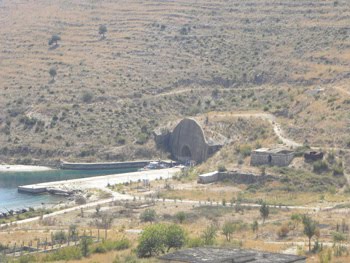
Russian Submarine Base
After a few hours, we are in Saranda where cruise ships dock. Tourists often come from Corfu to Saranda on day trips. Many people speak Greek here. We hear the greeting "Yassas!" along the cobbled promenade where ritzy restaurants mingle with fishermen boats.

View of Saranda from atop the Castle/Restaurant Lekuresi
Saranda is a perfect base for visiting the archeological ruins of Butrint, first settled by the Greek Illyrians in the 7th century B.C. Butrint was likely where people from the Greek world came to receive healing from the medicine god Asclepius. A temple still exists alongside later Roman structures, including a theater that could accommodate an audience as large as 4,000. When the Romans conquered the city, they created a 4 km long aqueduct and lavish buildings. Thereafter, the people here during the Byzantine era created several opulent churches, one constructed during the 5th century A.D. was comparable in size to Istanbul's Hagia Sophia. In order to preserve the church, archeologists have left most of the ruins underground.

Temple of Asclepius

Roman Theater

Byzantine Church (mostly underground)
After Butrint, we drive inland to Gjirokastra, first nearing the Greek-Albanian border. The famed Hoxha bunkers dot the terrain throughout Albania, but in this region they become far ore numerous. After Hoxha broke his ties with the Chinese in 1978, Albania was totally isolated and closed until 1992. Paranoid of an attack, Hoxha built 700,000 bunkers throughout the country. Jimmy explains that the cost of these bunkers could have provided a two-bedroom home for every Albanian family. Instead, Albanians between the ages of 18-55 had compulsory military training every year for one month.

Bunker

Bunkers Close To The Greek-Albanian Border
Today, off the highway several bottled water industries exist. We stop at the Blue Eye, the 100 meter deep spring. This is where tens of mountain springs meet. Eco-tourists will be happy to know that Albania has fresh water streams, which are not treated with chemicals. Spouts at restaurants and along the roads allow anyone with a container to take the free and plentiful beverage. The vegetables and fruits are also organic. After the fall of communism, fertilizer companies went bankrupt and farmers could no longer afford high-tech products.
The Blue Eye
Fresh Water Taps Are Everywhere
Gjirokastra, known as the silver city because of its glittering stone roofs and cobblestone roads, was the birthplace of Enver Hoxha. His family's home has been turned into an Ethnographic Museum displaying how wealthy families during the 19th century lived. At the top of the city, there's a citadel first erected in the 6th century A.D., then fortified by the Ottomans and used by Ali Pasha. Here is a view of the stone roofed homes from the citadel:

Gjirokastra
A teqe also perches along the cliff of this citadel. Teqe's are everywhere. Sixty-five percent of Albanians are Muslims, having converted during the 500 years of Ottoman occupation. Of these, about thirty percent claim to be part of the Bektashi order, a Sufi sect. Today, Tirana is the world center of Sufism, but we visit a teqe outside Gjirokastra called the Zadhil Teqe led by Baba Sadik Ibro.

Teqe
We drive back to Durres where we take the ferry to Bari, Italy and then a train to Naples -- but not before enjoying a last day at the Durres beach.

Durres
There is so much more to say about this country and its people. After being completely isolated under a brutal regime from 1945-1992, a pyramid scheme sent Albania's economy toppling in 1997. Nevertheless, ten years later Albania is safe, stable, and stunning. This resilience testifies to Albania's spirit of innovation that stems back to their ancient Illyrian roots. I highly recommend a trip to Albania. A great option is hiring a private guide. Jimmy Lama booked the hotels, drove us through the country, and was flexible about what we wanted to see. You can find him here.
Thank you, Jimmy Lama!
Saturday, August 28, 2010
Northern Albania

The Espresso Trek: "All of Albania is under construction," says our tour guide for the week, Jimmy Lama. And it appears to be true. Albania is undergoing a construction boom with upscale hotels, restaurants, and businesses developing constantly.
We cross the border into Albania from Montenegro. Because the government never invested in a railroad system, tourists can enter by land only through several border crossings with a car. (Ferries run from Italy and Greece. Tirana also has an international airport.) But the border guards are lax, letting us pass with the stamp of our passports. (Albania has been part of NATO since 2008 and has applied for EU membership.)
Crossing the border, I immediately notice cornfields and Mercedes. Before 1992 Albanians weren't allowed to own private cars. When the Communist regime collapsed, they believed the only car trustworthy enough to weather their roads was the Mercedes. So, second-hand lots cropped up everywhere. The automobile's reputation persists -- today, three out of five cars in Albania is a Mercedes.
Jimmy drives us through the northern town of Shkodra where Mother Theresa's parents lived, and possibly Mother Theresa herself until the age of four (although this is debated). The Rozafa castle perches at the top of the city, but with only seven days to see the whole country, we push on, driving along the Ottoman built Mesi Bridge.

Jimmy takes us to Kruja where a citadel touts magnificent views as well as the Skanderbeg museum, dedicated to Albania's national hero who routed out the Ottomans from this region in the 15th century. Skanderbeg monuments dot the entire country, his legendary battles as well as his mythical fighters (such as Mamica Castrioti) the pride of many Albanians because he ruled the area independently and created peace with the local rulers.

On our second day in Albania, we tour Tirana's city center where Skanderbeg's equestrian statue is surrounded by heavy machinery. The square is being renovated to become pedestrian only with the opera house adjacent to it. Along this boulevard, the opulent Taiwan Center has slick restaurants and cafes. The complex was built after Albania broke ties with China in 1978 and Enver Hoxha threw the entire country into complete isolation until the fall of communism in 1992.

Next stop is the Skytower, a skyscraper that overlooks the entire city. From here the deep colors of the city shine. The Tirana governor, Edi Rama, initiated a beautification project in the city several years back, painting the socialist blocs ochre, red, azure, and green. But the small water tanks on the socialist roofs still tell the story of how before 1992, the city didn't have 24-hour running water.

Our stay in the capital is short because Jimmy Lama suggests we enjoy the heart of the Albanian Mediterranean life. He drives us 45 kilometers to Durres, which became the capital of Albania after the country declared independence in 1912 from the Ottomans. It was also once the ancient port town of the Illyrians starting in the 7th century BC. After the Romans conquered the region, the city became one of the two starting points of the Via Egnatia, the road that linked Rome with Byzantium.

The city during the summer months burgeons with endless rows of hotels and restaurants along the beach. We eat a seafood lunch of fresh caught fish and shrimp and then visit the Roman amphitheater with a preserved mosaic from the Byzantine era.


We then stop for the night in Vlora, where the Adriatic and Ionian seas split. We stay at the New York Hotel and from the terrace watch the setting sun.

We notice, above all, that the Albanians are generous. Although prices for Western pockets are at least fifty percent less (a 4 star hotel costs 40 Euro for a double room and meals for four people run at about 35 Euro), the Albanains never hesitate to give us more than we pay for and make doubly sure that our bill is exact. The country survives on a dual currency of both Euros and Lek. Credit cards are accepted at major hotels, but not encouraged due to the 3% surcharge that proprietors must pay. So, as a courtesy, we don't use our credit cards. For that, bank machines are everywhere.
Tomorrow -- it's on to the south.
Friday, August 20, 2010
Ulcijn, Montenegro
The Espresso Break: We've made it to the Ulcijn, Montenegro just north of the border with Albania. To get here, we took an overnight train from Belgrade to Bar, Montenegro and then took an inexpensive taxi drive 25 km to Ulcijn. Known for it's sandy beaches, Ulcijn is a predominantly Albanian town. Signs are in both Albanian and Montenegrin (closely or, some argue, the same as Serbian).


We first visited the Citadel, which has a bevy of restaurants at the top touting fresh catch of the day and stellar views of the crystal clear ocean. A museum displays some Greek and Roman artefacts as well as Turkish cannon balls.

The beach at the bottom of the citadel gluts with tourists, restaurants, and cafes. When I ask which tourists are most common here, the answer is Kosovars. But we've met Poles, Macedonians, Russians, and Serbians as well.

Not far from the Old Town and Citadel, Ulcijn has a 12 km long beach called the Veliki Plaza. Here, vendors barbeque corn that they sell for one Euro (Montenegro has been on the Euro since before they declared independence from Serbia in 2006 through a referendum).

Nearby, we walk above a bridge where we see fishing huts and nets. I'm not sure what they catch specifically along here, but the fresh fish and calamari abound. There's nothing quite like it.

We've come to Ulcijn because it's the best way to enter Albania overland. Tomorrow, we take a car across the border and to Tirana. Still, Ulcijn has turned out to be a wonderful vacation hot spot where we've taken time out to enjoy the beaches.
Thursday, August 19, 2010
Bucharest: The Paris of the East
The Espresso Trek: In the late 1800's, the boulevards of Bucharest were constructed after Haussmann's Paris and the Cismigiu Gardens were crafted in Viennese style.

Today, the Palace of Parliament is one of the main attractions. At 365,000 square meters, it's the second largest building in the world next to the Pentagon.

Built in 1983 by the Communist leader, Ceausescu, the interior has one million cubic meters of marble, 2,800 chandeliers, and 3,500 tons of crystal.

In order to know where he was at all times, Ceausescu had a map of the building constructed on the floor of the rooms.

The palace is now used for conferences and other events. In the glass-ceilinged Sala Unirii room, for example, Romanian gymnast Nadia Comaneci got married in 1996.
The Alexandru Ioan Cuza room has a balcony that overlooks the boulevard constructed to mirror the Champs-Elysees.

Interestingly, we've met two Romanians who said they wished Ceausescu's regime would return because there were good things about his government, such as that everyone had jobs. Another Romanian commented that this is a common attitude, but "they forget that during Ceausescu there were also ration cards". Bar none, every Romania we've met has gone to work abroad for a time, usually to Italy.
Today's Bucharest still feels a bit drab, the tourist attractions lying outside the capital. But apparently, the restaurant and dance-club life is as opulent as any other city in the West.

Tuesday, August 17, 2010
The Painted Monasteries
The Espresso Trek: It’s where warrior martyrs beat back demons and the Apocalypse beast blows flames at angels. These are the painted monasteries, located in the northeastern part of Romania.
Surrounded by stone walled fortifications, the monasteries sprout up from the valleys of the Carpathian Mountains. King Stephen the Great of Moldavia first began construction of these Orthodox churches during the 1500’s. Still today Romanians hail ‘King’ or ‘Saint’ Stephen as a national hero; during his long reign, he fought and won forty-six out of forty-eight battles, many against the pagan Turks. To commemorate his victories, he purportedly constructed forty-four churches.

We arrive at the logging village of Guru Humorului and hire a local guide, Danil, who expertly winds us through the (sometimes unpaved) roads. We start with Voronets (shown above). The monastery is shaped like a ship (arc) and the wooden roof fans out into eaves. Our guide, Danil, explains that researchers have scoured the Bucovina region, always unsuccessfully, in search of where the artists of Stephan’s time found the lapis lazuli that so richly color the walls.

Each monastery has a well offering fresh water to visitors, who haul up a bucket and then scoop out a drink with one communal cup. Fresh water in Romania still abounds and we wonder how long it’s been since we’ve tasted the beverage -- untreated.

Next Danil drives us twenty-five kilometers to Moldovitsa. We walk to the Western wall (exonarthex) where the Last Judgment displays, among other things, another fiery river with Dracul at the bottom. The entrance to the church is here, the idea being that a church is heaven on earth, but parishioners can only get into heaven if they pass through the Last Judgment first.
Our guide next takes us to the large Suchevitsa citadel. We enter the citadel walls and are immediately graced with a vast image of the Ladder of Virtue where men step up with their good deeds, while crimson and emerald green angels pray for their success. But many still fall down the rungs, pulled down by demons.

Our last stop is the Humor Monastery. The Last Judgment here depicts a scarlet woman as the devil. It comes from the folktale of this region that hell is a cavern upheld by seven old women who are more evil than Dracul himself. The women are mortal, so Dracul always has to find replacements – and he always has an abundance of choices.
We return to Guru Humorului and enjoy dinner at a former communist milk-bar, eating sour soup, boiled potatoes, and snitzel. Out here in the middle of nowhere, we’ve decided that the painted monasteries are truly one of the contemporary wonders of the world.
The Cauldron Makers

Part II of Dan Marin's Tour:
A Visit To The Roma Village of Saticel
The Espresso Trek: They often travel by horse cart. During the summer months, they pick porcini and wild berries in the forest, selling them on the side of the road. The official number of Roma living in Romania is 500,000, but they are estimated to be more than 2 million.
After our tour of the Shepherd's Village, Dan Marin of Transylvanian Wolf drives me to a village that begins on the other side of a bridge. Here, the road turns to gravel and married Roma women wear colorful headscarves while unmarried girls wear their hair in braids. The Roma, Dan says, tend to live outside Romanian towns and inside their own villages. They often remain tight-knit because the Roma have a strong sense of the gadge or foreigner, that is, anyone who isn’t Roma. This concept allows communities to retain their unique traditions and identity.
In Saticel, a village of one-thousand, the Roma still make cauldrons out of copper to sell at the markets. Hence, they are known as the Caldari or cauldron makers. Dan explains that the Roma divide themselves into eighteen diverse groups, named after their professions, such as the jewelry makers and the woodworkers. The musicians (called lautari) are famous for having inspired classical composers such as Franz Liszt and Johannes Brahms.
I ask if discrimination against the Roma in this region is widespread. Dan says that it depends. Many Romanians, like Europeans in general, blame all the social ills of society on the Roma. Others idealize the gypsy life. For example, the British writer, William Blacker, lived in Romania from 1996–2004 and wrote Along The Enchanted Way that chronicled his life with a Roma girlfriend and her community. Lately in Zarnesti, however, there have been discussions about how the Roma in Saticel obtain the copper to make their cauldrons. Some claim they pilfer the necessary materials from the railway lines.

Up a slope from the bridge, we come to a fork in the road where a boy races his motorbike. Dan tells me that the Roma tend to adopt the language of the country in which they live, often never learning Romani. They also convert to the religion of that country. But the locals in Saticel say that their community is divided by the fork in the road. On the left side of the road, the Roma have converted to sectarian religions (mainly Pentecostal). On the right side, they have adopted Eastern Orthodoxy, the religion adhered to by eighty-five percent of Romanians.

Dan turns right and we drive down a row of two-story homes. Petre Gabor, the Bulibasa (leader) of Saticel, lives somewhere in the middle. Like Dan, he is Eastern Orthodox. He is also fluent in Romani. His wife, Argentina, welcomes us inside and the rooms look impeccable with colorful carpets and artwork on the walls. But a hallway on the second floor has only wooden planks and dry wall. Petre explains that he is remodeling the upper floor in hopes of eventually using their home as a bed and breakfast for those interested in learning more about Roma culture.

After Dan and Petre spend some time talking about their upcoming projects, we drive back through Transylvanian towns. Today, the jobless rate among Romanians in Zarnesti is high, but the unemployment rate among the Roma reaches 96%. Dan and Petre together work hard to reverse this situation. Dan created the ‘Fundatia Rowan Romania’ charity program, which among other things, helped find employment for a Roma woman and gives guided tours of the Roma village as well as tourist presentations of traditional Roma dance and music. Dan is proud to tell me that his work has become so well respected that last year, for the first time ever, the Zarnesti town hall invited the Roma dance group to perform at their annual Romanian Festival.
While in recent months the French Prime Minister Nicolas Sarkozy began deporting the Roma population from his country, Dan’s approach to his Roma neighbors is different. He has reached out on the local level and continues to work for mutual cooperation and understanding.
Thank you, Dan Marin!
Subscribe to:
Posts (Atom)