Showing posts with label Teatro San Carlo. Show all posts

Tuesday, October 19, 2010

Caffe Con Panna


The Espresso Break:  The great Neapolitan impresario, Domenico Barbaja, started out as a simple waiter in Milan.  He went on to build an empire of cafes in northern Italy that often became fronts for his gambling parlors.  His money brought him to Naples where in 1809 he became the director of the internationally renown Teatro San Carlo.  He brought opera singer Isabella Colbran to the theater as well as Giachino Rossini (Barber of Seville).  Domenico lived in a Palazzo along Via Toledo, today only a few steps from the Galleria Umberto:


Folklore has it that Barbaja made his first big windfall of money through the creation of a signature beverage called the Barbajata.  Today, the Teatro San Carlo only serves espresso and capuccino.  Throughout Naples, as far as I can find, nobody has ever heard of the Barbajata.  The drink, however, still survives.  Some claim that Barbaja invented the cappuccino.  I think this is far fetched.  More likely the beverage still survives in a modern day form called the Caffe con Panna or Coffee with Whipping Cream.


Simple and elegant, I made this one at home (see picture above).  Tribute to Barbaja can also be found at the Teatro San Carlo where his bust stands inside an intermission hall:


(A Note about the Espresso Machine:  I made the above beverage using my Saeco Via Veneto machine.  The espresso machine was invented only in the early 1900's.  The machines were created by Northern Italians.  More than 75% of caffe in Naples is still drunk at home, usually made heating up a Moka on the stovetop.  Today, Bosco is the company that makes vintage espresso machines in Naples for use in cafe-bars.)

Friday, April 30, 2010

The Bourbon Tour

The legacy of Bourbon rule (1734-1798) can be seen through their dazzling buildings. Today, I'd like to give a visual tour of their reign.

In 1734, Don Carlos of Bourbon took over rule from the Austrians and was crowned King Charles of Naples. His first stop was to pay homage to the remains of Saint Gennaro, the patron saint of the city, whose blood liquefied immediately. The Bourbons, thereafter, reversed two centuries of Spanish colonial oppression by initiating civic Enlightenment ideals.

Herculaneum and Pompeii were discovered during King Charles' rule. Well-known artists also visited the city during this era, including Rousseau and Goethe. But the stunning mark King Charles left on the city was architectural in nature.

The Teatro San Carlo turned Naples into an epicenter of musical genius. Castrati such as Farinelli sang here and Rossini (The Barber of Seville) worked here:

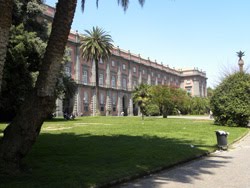
King Charles built the Royal Palace of Capodimonte, which today houses some of the finest artwork in the city, including two Artemisia Gentileschi paintings and an Andy Warhol picture of Mt. Vesuvius:


The Royal Palace of Caserta marked the pinnacle of architect Luigi Vanvitelli's career. Located about 15 miles north of Naples, the palace models Versailles, especially with its opulent gardens:


This was also a time mysticism and science gained prominence, as seen through the artwork commissioned by alchemist, scientist, and nobelman Raimondo Di Sangro in the San Severo Chapel. Guiseppe Sanmartino scuplted the Veiled Christ in this chapel.

In 1759, King Charles abruptly abdicated and left eight-year-old Ferdinand in charge. Ferdinand's reign was one of the longest in European history. He was beloved for his Neapolitan dialect and known for setting up a small stand each evening in the market to give away his hunted game or catch of the day. He also established the lottery and a silk factory meant to become an industrial social utopia. Ultimately, the project failed, but San Leucio, near the Caserta Royal Palace, still exists:


The Parthenopean Republic in 1799 brought the Bourbon reign to an abrupt pause. But it failed within a year and Neapolean's French troops entered the city. A husband of Napolean's sister, Joseph Murat, took over. During his fifteen years of rule -- before Napolean's defeat and Murat's own execution by firing squad -- he commissioned the Piazza Plebiscito adjacent to the Royal Palace:


King Ferdinand returned to the throne in 1815. He ruled until his death in 1859. Two years later, the Kingdom of Naples came to an end and the city unified with the rest of Italy.

Book Recommendation: The best English language history of Naples is -- In The Shadows of Vesuvius: A Cultural History of Naples by Jordan Lancaster. If you love Naples, you'll enjoy reading this more than once.