Thursday, May 28, 2009

A Taste of Japan


(Pictures: Centro Bonsai greenhouse, including a plant grown for the last eighteen years by the greenhouse owner. )

Chi lascia la strada vecchia per la nuova sa quel che lascia, ma non sa quel che trova.
(Who leaves the old street for the new one, knows what he left but not what he'll find. OR
Better the devil you know than the devil you don't know.)


Nook of Naples: When I ask a Neapolitan: "Where are you from?" I usually get the same answer: Naples. In general, people are born and live in the Campania region all their lives surrounded by family. What's more, the Neapolitans tend to be fiercely proud of their local heritage, from their two thousand year history and their art to their internationally renown cuisine. Living here, therefore, means being immersed in everything Neapolitan.

But as a metropolitan port city, I also search for its international flair. What I have found is a niche of Japanese aficionados.

The Naples Bonsai Club offers classes in the Japanese art of cultivating Bonsai. The club itself is a sprawling greenhouse consisting exclusively of Bonsai. Well, okay, not all the plants are Bonsai because students begin their training with indigineous Mediterraean plants that are easier to pluck and prune.

The Bonsai Club is a bit difficult to find, hiding down a steep incline behind a gated parking lot. But with a GPS and a little adventurous spirit, plus the telephone number from the website on hand, you'll enter a take-me-away world of plants and sunshine. The owner proudly gives visitors a tour, including the Bonsai he himself has cultivated for over eighteen years. They're all Italians and if you stay a while, they'll offer you espresso from a thermos. They adhere to strict Japanese forms of Bonsai cultivation and over the years, as the pictures on the walls attest, they have invited Japanese teachers to Naples many times.

La Cucina Giapponese: Three exquisite Japanese restaurants in Naples mirror the seriousness of the Italian cooking experience here. The swell of Italians on the weekends also shows how highly the Neapolitans prize sushi, sashimi, and tempura:


A little slice of the Orient feels apropos considering that Naples was once home to traders who came to this port town from everywhere bringing spices, exotic animals, and more. Today, the Japanese flavors of Naples are small, but a real treat once found.

Wednesday, May 20, 2009

The National Archeological Museum -- Top Five Must-See's


Nook of Naples: Boasting one of the largest collections of ancient Roman artifacts, the National Archeological Museum can be visited over and over again.  But what to look for and not get overwhelmed?  Here are my top five picks:


1)  La Villa dei Papiri displays fantastic bronze sculptures (look for the Bust of Seneca) as well as a few papyrus scrolls.  These items were discovered in Herculaneum in a villa believed to have been owned by the father-in-law of Julius Caesar.   The largest part of the papyrus scroll collection can be found at the National Library, but here you'll see the rudimentary gadgets initially used to unroll the scrolls.


2)  The Secret Cabinet is an ongoing favorite.  Displaying erotic statues such as Pirapus and sexually explicit frescoes from Pompeii, the area is off-limits to children.


3)  The Battle of Alexander:  The largest and oldest villa in Pompeii -- the House of the Faun -- once had a mammoth floor mosaic displaying Alexander the Great's victory over the Persian emperor Darius.  The mosaic is now housed in the museum.


4)  Farnese Hercules is a Roman copy (3rd century A.D.) of a lost Greek sculpture made by the Greek sculpting master, Lysippus, in the 4th century B.C.


5)  Paquius Proculus and His Wife is the original 1st century A.D. painting from Pompeii that is famously seen in reproduction.  You'll recognize it when you see it:


There's much more to explore.  The museum also has the third largest collection of Egyptian artifacts and re-creates the Temple of Isis.  The Farnese collection includes the largest collection of Roman copies of classical Greek sculptures -- the only surviving indications of those lost works.  And finally, if you take my Phlegraean Fields and Villas tours, you'll then find a bevy of artifacts from those sites, including Baia, Boscoreale, Stabia, and Cuma.

Getting There: Take the metro to Piazza Cavour. When you exit the station, the museum is up toward your left.  Address:  Piazza Museo Nazionale, 19

Friday, May 15, 2009

Herculaneum: A Self-Guided Tour

Bird's Eye View Of Herculaneum

Herculaneum, as the myth goes, was founded by Hercules. The town does have Greek origins, the city having come into existence sometime in the 6th century B.C. The Romans had conquered Herculaneum by 89 B.C. and soon the city became a high-class resort, which included many patrician residences. The eruption of Mt. Vesuvius, however, plunged the city into a huge river of boiling mud and debris ten meters deep. The population probably had time to escape to the sea, but they were forced back to the shore by a violent tidal wave, as evidenced by the human remains found lying next to boats.

In 1709 Austrian Prince d'Elboeuf discovered part of Herculaneum's theater and in 1738 the "Villa of Papyri" -- an area still not open to the public -- was found with a library consisting of 2,000 papyrus scrolls. Today, the scrolls are housed in the Naples National Library located downtown and the National Archeological Museum preserves the other treasures found in the Villa.

After leaving the ticket office, a long bridge curves above the entire city, giving a bird's eye view of its streets and buildings. What makes Herculaneum so unique is that these well-preserved structures include wood materials that normally would have decayed if the city hadn't been covered by volcanic ash.

What to see:

Wandering over the bridge, you then walk up a long street straight ahead.  Take a right turn at the very end and you come to the Welder's Shop with terracotta vases. Next to this house is a preserved lead pipe -- evidence that the city once had a highly developed plumbing system.


Preserved Lead Pipe

Take a right down down another street and you immediately come to the House of Nero's Living Room. This villa shows the opulence and grandeur though its large atrium and faded frescoes.

A little further down along this road also is the most impressive sight of the entire site -- the House of the Neptune and Amphitrite Mosaic. This wall mosaic located in the summer dining room shines with vibrant colors.


Neptune and Amphitrite Mosaic


More of the Neptune and Amphitrite Mosaic

Further along the same street the Trellis House, which still has the original wood and reed laths. This used to be a lower class multi-family dwelling.


Trellis House

Go down to the end of this street and turn left.  Turn left once more.  You enter the impressive House of the Stags that contains sculptures of stags inside. This villa once had a view to the sea.


House of the Stags

Leave the villa and turn left up the street to the Gymnasium. To your right is a vast area that was once dedicated to sporting activities.  A tunnel inside the gymnasium was once the entrance to the indoor pool. Now, a large hydra replica adorns the hollow space.


Hydra in Indoor Pool

Return back toward the House of the Stags and follow the stairs until you reach the Ancient Beach where archeologists found more than 300 skeletons of people trying to escape in boats. They also uncovered a nine-meter long ship.


The Port

A bridge passes from the port to a tunnel where stairs take you back to the entrance. You pass a house that has an exhibition re-creating what Roman ships looked like.


Here are some other gems you can find along the tour:


Road With Water Fountain At End


Water fountains exist on many blocks


Theater Mask


Across street from Villa of the Stags, this marble picture depicts a surgery

Getting There: Herculaneum sits on top of the present day city of Ercolano. It's fairly simple to get there and taking the autostrada is a welcome break from the bumper to hood traffic of downtown Naples. A map is provided in .pdf file at www.pompeiisites.org.

La Cucina Napoletana: Several other toppings also make pizza quintessentially Neapolitan. In the last post, I included a recipe for making pizza dough. Here I only add the regional toppings common on most restaurant menus. From the book Cucina Napoletano by Roberta Avallone:

Pizza with Fresh Anchovies
Clean the anchovies, de-bone, cut off the head, and rinse under running water.
Drain the filets in a strainer and pat dry.
Spread the anchovies on the pizza dough.
Peel 2 cloves of garlic and slice very thin, then sprinkle around the pizza.
Douse a bit of olive oil on the top.
Season with salt and pepper.
Bake at 450 degrees Fahrenheit for about 40 minutes.

Sailor's Pizza
Clean 1/4 cup clams and 1/4 cup mussels.
In two separate pans, heat a little olive oil and thin sheets of garlic (1-2 cloves), then add the clams or mussels and cover until they open. Next, de-shell.
Fry 2/3 cup shrimps quickly in a pan.
Boil 2/3 cup calamari and then cut into strips.
Flavor about 1 cup of tomato sauce with crushed garlic and parsley.
Spread the tomato sauce on the dough, then add the clams, mussels, shrimps, and calamari all around.
Sprinkle parsley on top.
Bake at 450 degrees Fahrenheit or as high as you can for about 10 minutes or until ready.

Four Seasons Pizza
Make indentations into the pizza dough with a knife to make four sections.
Ladle tomato sauce on the whole pie.
Spread diced mozzarella cubes on one of the four sections.
Spread artichoke hearts in oil onto another section.
Spread green olives onto the third section.
Spread anchovies onto the fourth section.
Bake at 450 degrees Fahrenheit for about 30 minutes.

And remember -- Neapolitans make pizza with a thin crust. Spread the toppings only in small portions; don't heap them on the pizza. Unless it's a snack on the street, usually a whole pie is eaten by one person using a fork and knife.

Buon Appetito!

Wednesday, May 13, 2009

Pompeii: A Virtual Tour

For those who would like a virtual tour of Pompeii that goes along with my self-guided tour, here are some pictures of the places I mention:


1)  The Forum:  Granary with pottery and plaster casts.  


The Temple of Apollo is the oldest in Pompeii, dating back to the 6th century B.C.


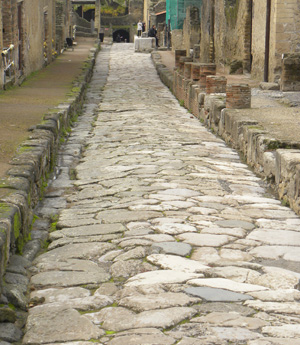
2)  Via Dell'Abbondanza:  The liveliest street in Pompeii, the streets were high because they were filled with garbage.


3)  The Brothel:  Bedrooms are broad slabs for sleeping.  The frescoes show many different sexual positions.


6)  Thermopolium of Vetutius Placidus:  This thermopolium looked out onto the street and had benches as well as dolia (terracotta receptacles) that contained food. 


7)  House of the Ceii.  A large hunting scene with Egyptian themes.


8)  House of Octavius Quartio:


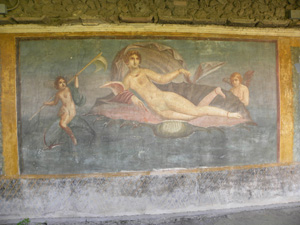
9)  House of Venus:  A tacky Venus fresco. 


10)  The Amphitheater:


11)  Via dei Sepolcri: Ex-slave Publius Vesonius Phileros lies beside his ex-owner Vesonia and his ex-friend.


12)  Garden of the Fugitives:  Plaster castes.


13)  House of the Ship 'Europa':  Olive oil press.


14)  Temple of Isis:   


15)  The Great Theater and Small Theaters:


16)  The Forum Baths: 


17)  House of the Tragic Poet:  Mosaic of a barking dog.


18)  The House of the Faun:  A statue of a bronze faun dates back to the second century B.C.  


19)  Villa of the Mysteries:  Dionysian or Orphic initiation rites.


Tuesday, May 12, 2009

Pompeii: A Self-Guided Tour


Del senno di poi son piene le fosse.
(Graves are filled with after-the-fact wisdom.)

The most visited attraction in the Campania region, Pompeii swells with tourists most of the year. Because archeolgoist have re-created a veritable Disneyland of the ancient world, nowhere else can you find the wealth and expansive feel of walking back in time.  My first suggestion is to try and visit on a weekday in the middle of winter -- that's when you'll get the city almost all to yourself.

This self-guided tour of Pompeii is for anyone who prefers to walk through the vast ruins without the drone of improbable bits of history. Instead, I suggest first reading Pompeii: The Life of a Roman Town by Mary Beard, which describes the smells, sounds, and characters of this frozen city.


Pompeii was founded around the 6th century B.C., so by the time Mt. Vesuvius erupted on August 23, 79 A.D. the city already had a several hundred year history.  Most of what you see today is how the inhabitants in 79 A.D. lived.  The decorating style of Pompeiians are worth noting from the start.  They adored Greek art and culture, which for them dated as far back as the Renaissance does for us. They also admired Egyptian art and religion, building temples to Egyptian deities and decorating their homes with Egyptian motifs. The world of the Pharaohs for them looked as far away as the Roman world does to us.


Okay -- so gear up!  When you buy tickets at the entrance across the street from the Pompeii Circumvesuviana, go to the information desk and get yourself a map and small description booklet.  Then, using the map, see the following sights in this order.  This self-guided tour can take you anywhere from 3-5 hours depending how fast you walk.


What To See:

1)  The Forum:  Walk from the entrance through the Sea Gate, an inclined cobblestone pathway that goes under an arched tunnel.  (Remember, Pompeii was once a port town.)  You then spill into the center of the city, called the Forum. Take a look at Mt. Vesuvius in the distance and imagine that day when pumice spewed across the sky.  The Forum itself is surrounded by public buildings, including the Temple of Jupiter, the Temple of Apollo, a storehouse with pottery and plaster casts of Pompeiians, and a market where the woolen cloth guilds once sold their wares.  The Temple of Apollo is the oldest in Pompeii, dating back to the 6th century B.C.  The largest building in the Forum, the Building of Eumachia, was sponsored by a wealthy female priestess.

2)  Via Dell'Abbondanza:  The liveliest street in Pompeii, the name was made up by archeologists along with every other street name in the city.  We don't know what the Romans called these thoroughfares.


Follow this street to see shops with dolia that sold all manner of food.  Pompeii was most famous for its garum, or fish sauce.  Some of these places were stores, others were bars.  Tour guides will tell you that Pompeiians always ate lunch outside the home.  But, in truth, most people lived in cramped small quarters, so they lived most of their lives outside.  Oil lamps within the restaurants and bars hint that the street had customers all day and all night.


The street has very high stones because garbage collection always posed a problem.  These streets were likely strewn with refuse dumped from chamber pots, animal dung, rotting vegetables, and even human corpses.  The smells would have been strong.  Notice also there are no drains in the streets, so when it rained the roads would turn into torrents of water.


The large blocks at the end of the streets barred wheeled transport from entering (particularly into the Forum).  One-way streets were common, which kept jingling carts moving without colliding within the narrow streets.

3)  The Brothel:  Situated on Brothel Lane, a narrow side-street off Via Dell'Abbondanza, the brothel has a small hallway with several bedrooms to the right and left. Inside these bedrooms are broad slabs for sleeping.


This was the largest brothel of the city, run by a woman, but prostitutes in Pompeii were everywhere.  It's posited that they weren't allowed to wear standard women's clothes, dressing in a man's toga instead.  Prostitutes were slaves as well as free women, but never respectable citizens.  Their customers would have ranged from actors and gladiators to seaman coming from the port and illustrious Roman citizens.  


Graffiti left by customers indicated that most Pompeiians were literate.  The frescoes show many different sexual positions and it's thought that perhaps a man would point to one of the pictures before entering a bedroom with his prostitute, letting her know what kind of service he would enjoy for the night.  Prostitutes wouldn't have necessarily known Latin or have been literate.  Pompeii, interestingly, was a multi-lingual city with Oscan used just as often as Latin.


Along  Via Dell'Abbondanza, here are three 'Must See' houses:

4)  House of the Chaste Lovers:  The front of this building was a bakery and behind it a dining room and living rooms.  A mule carcass was found here in situ, showing how the owners ran in haste during the eruption, leaving their animals behind.  The mules lived in the house and were used to drive the millstone for grinding wheat.

5)  House of the Painters:  Lavish frescoes were being painted by a cadre of professionals who hopped up and left without their brushes and paints.  From their abandoned products we catch of glimpse of how painters created their frescoes.

6)  Thermopolium of Vetutius Placidus:  This thermopolium looked out onto the street and had benches as well as dolia (terracotta receptacles) that contained food.  Behind the restaurant is the owner's house with a Rape of Europa frescoe located in the garden triclinium.  (A triclinium was the place where Romans ate their meals, probably on long couches.)


7)  You can also take a side road off Via Dell'Abbondanza right before the House of the Painters and visit the House of the Ceii.  A campaign message on the house's facade has the name L. Ceius Secundus.  A large hunting scene is painted on the back wall of this house with Egyptian themes.


Toward the end of the excavation area on Via Dell'Abbondanza are:


8)  House of Octavius Quartio:  Two long pools have a temple in the middle and frescoes on one end.  This was once an outdoor dining area for a wealthy family.


9)  House of Venus:  A tacky Venus fresco was painted in the back of the villa.  During WWII bombs fell on Pompeii, destroying this villa.  But archeologists reconstructed it -- showing how Pompeii is far more of a tourist-friendly Disneyland than accurate portrayal of excavations.  In fact, most of these re-created homes were thirty feet underground and, piece-by-piece brought to the surface and then reconstructed.  Much of what we see today has been created with much artistic license by archeologists.


Take a right turn at the end of the road and you'll see the Amphitheater up ahead.  Remember, archeologists still haven't excavated all of Pompeii.  The city was much larger than what you see.  


10)  The Amphitheater:  At the far end of Pompeii, the amphitheater could hold up to 20,000 spectators. Adjacent to it was the gymnasium surrounded by porches and a swimming pool in the center. This was where gladiators trained.  Gladiators were often slaves or condemned criminals.  A lanista or a troupe manager controlled when the gladiators performed, scouted for new recruits, and acquired the animals from distant parts of the empire.


The gladiators themselves lived in barracks with no traces of beds found.  They kept bronze decorated helmets and an assortment of daggers in their rooms.  The death rate among gladiators was about 1 in 6 for each show.  Some fame came with the best fighters and it was said that they had enormous sex appeal for the women.  However, considering most of the graffiti, such as Celadus, heartthrob of the girls was written in the gladiator barracks, these notes were likely written by the gladiators themselves who faced a short life in cramped quarters, never getting a girl.

11)  Via dei Sepolcri: The main roads connecting Pompeii to the outside world used to be bordered, as was the custom at the time, with tombs. Side by side with poor graves were several rich sepulchral monuments. Marble statues of families can still be seen above their tombs along with Latin inscriptions. Eumachia's is the biggest tomb uncovered. 


 Nearby, the ex-slave Publius Vesonius Phileros lies beside his ex-owner Vesonia and his friend. Their statues stand side by side, their heads missing. Phileros added a plaque before he died that says:  "Stranger, stop a little while if it isn't too much trouble and learn what to avoid. This man that I had hoped was my friend -- it was he who produced accusers against me and started a court case. I thank the gods and my innocence that I was freed from all this trouble..."


Many Pompeiians took this road as they fled the city, carrying their valuables with them.  One man carried a sword, another woman carried a figurine of the goddess Fortuna.  Children kept up with parents.  But they didn't make it past this road and succumbed to the ash.


Check the map and ask directions.  This is where the walking tour can get a little confusing.

12)  Garden of the Fugitives:  A vast number of plaster castes lie next to these vineyards in a large glass case.  Giuseppe Fiorelli, director of the Pompeii digs in the late 19th century, invented the plaster cast method.  Liquid plaster was poured into a cavity left in the bed of ashes by the gradual decomposition of the victim's body.  As the plaster solidified, it reproduced the body's shape.


13)  House of the Ship 'Europa':  A large garden here may have once grown beans, onions, cabbage, grapes, and more.  Their seedlings were kept in 28 terracotta vases found along the boundary wall.  Animals were raised in the stalls at the back of the garden.  The front room displays an impressive olive oil press.

14)  Temple of Isis:  Worship of Egyptian deities was most prominent in Pompeii.  Here, initiates bathed themselves in water brought from the Nile. 


The city likely contained as many deities as the number of living inhabitants. Generally, there were no tenets of belief.  Instead, religious worship was active, most often centering around communal animal sacrifice. Handouts of animal meat from the sacrifices were given to the rich, not the poor.  New gods could be recruited from among mortal men, in particular emperors.  Isis, however, was an Egyptian goddess and this temple was built at the end of the 2nd century B.C.  Two other Egyptian deities are honored within the niches.  

15)  The Great Theater and Small Theaters are just up the way and to your left from the Temple of Isis.  Pompeii was a theatrical town and by now you've seen that houses were decorated with images from the stage.  The pantomime was a major attraction in Pompeii and a portrait at the Temple of Isis as well as at the Building of Eumachia in the Forum commemorate Caius Norbanus Sorex, who was a mime actor.  

Return to Via Abbondanza and enter the Forum. From there, go up toward the newly constructed cafeteria and have a snack. A few steps from there are the newly renovated:

16)  The Forum Baths:  Wherever there is Roman culture, there is a Roma bath.  Here, Pompeiians exercised, steamed, swam, gamed, or enjoyed barber services.  The baths were a social leveller too, only the richest having heir own private baths at home.  


The baths in Pompeii are larger than the Forum itself.  The construction of a male and female bath house dates back to about 80 B.C. Since most people didn't have indoor plumbing, this was where they came to wash. The baths had a changing room, a room for cold baths, lukewarm baths, and hot baths. Today the visitor can still see stucco friezes and frescoes in these rooms. In the lukewarm bath, terracotta figures of Atlas support a freeze with entwining plant motifs. In the hot water bath, a mammoth marble fountain adorns the front niche.

17)  House of the Tragic Poet:  Just across the street from the exit of the forum baths, this house has an impressive mosaic of a barking dog.

18)  The House of the Faun:  The largest of all the villas and the most famous, this wealthy dwelling had airy rooms and some indications of indoor baths, toilets, and kitchen areas.  When entering the house, a statue of a bronze faun dates back to the second century B.C.  Most impressive is the mosaic -- using somewhere between 1.5 and 5 million tiny stones or tesserae -- depicting a battle between Alexander the Great and the Persian King Darius (the original now housed at the National Archeological Museum).  This house in 79 A.D. would have been stately and yet considered old-fashioned, built first in the late 2nd century B.C.


From here, walk back to the House of the Tragic Poet and then pass it, coming to the end of the road. Turn right and amble along another street going downhill. Eventually, you come to what looks like a country road.  You round a bend and enter the most impressive of all:

19)  Villa of the Mysteries:  Frescoes with deep red backgrounds depict Dionysian or Orphic initiation rites.  The images lead archeologists to believe that this impressive villa was owned by a priestess of the Dionysian cult.


From here, you can exit and walk straight along the road until you hit the Circumvesuviana.

Getting There: You can either take the Cicumvesuviana train, which conveniently lets you out right next to the entrance gates or you can drive. Pompeii is right off the autostrada and easy to find using Mapquest and several lots allow for easy parking availability.