Wednesday, March 31, 2010

The Basilica in Capua


Nook of Naples: Catholic Churches number in the hundreds here. Open to everyone, they provide quiet reprieve from the frenetic city traffic and display stunning works of art for free. And they also often transport visitors back through centuries of medieval, Byzantine, and ancient history.

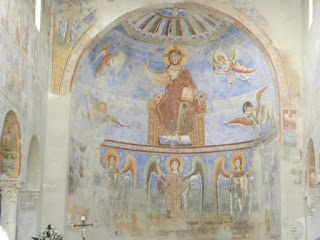
The Basilica Benedettina di S. Michele Arcangelo, located in the outskirts of Capua, used to be an impressive Temple of Diana. The church lies at the bottom of a hilly area, known as 'Tifata' that during ancient times was densely forested. Rich with oak trees and spring waters, the cult of Diana -- goddess of the wood and hunt -- spread here.

We still don't know exactly when construction of this temple began. Scholars say that active building work took place at the end of the fourth century B.C and the beginning of the third century B.C. According to an inscription still visible on the floor, the Romans rebuilt the temple in 74 B.C. The date that the temple was transformed into a church is unknown. According to a literary tradition lacking historical evidence, the Longobards built a church consecrated to the Archangel Michael about the sixth century A.D. By 1065 the Norman, Richard I built a monastery here.


The church itself is interesting testimony to the fact that once Christianity took hold in Campania, the worship of gods and goddesses didn't immediately eclipse, but rather was slowly absorbed into the predominant religion. The cult of Mithras, for example, whose temple can still be visited in Capua, came from Persia and was very popular in the Roman empire. Worshippers celebrated the birthday of Mithras every 25th of December. Is this coincidence or did the early Christians adopt this date in order to gain more followers? (After all, the Bible gives no indication of Jesus' actual birth date.) More importantly, ancient temples and their materials were used to build new churches, certainly thereby bringing down the costs of construction.


Mysteries abound about this church because few manuscripts still exist detailing its construction. But walking along its ancient floor, past its columns, and admiring its Byzantine frescoes, a visitor can visually travel through time.

Sunday, March 28, 2010

My Favorite Wine Shop


The Sunday Hop:  Every Thursday morning at 5:00 am, trucks come from Terzigno (a vineyard near Pompeii) to drop off twenty-five mammoth 54-liter jugs of wine at the family-run Il Vignaiolo


Angelo has owned the shop for thirty-eight years.  He and his son, Antonio, together sell elegant wines and provide a quaint reprive for regulars who come and sip a cup of wine poured from wine spouts along the wall.  Many people also bring empty plastic water bottles, which they fill for a mere 1.50 Euro.


The wine shop also has its own underground -- one of the many privately owned cavities in the city.  The cellar of Il Vignaiolo, during ancient times, was a street of Naples.  Today, a small lift transports beverages to the bottom and the owners use the spiral staircase to keep the shelves of their shop stocked.  The cellar consists of three large rooms.  At the very back, an old Greek well is used for storing empty boxes and crates.


When I visit, I'm served coffee and meet the whole family, including Stephanie Dardanello (the American wife of Antonio) and Carolina (the mother who often cooks for everyone in the shop's back kitchen).  


I ask them my most burning wine question:  Why are so many red wines in southern Italy fizzy?  Often I'll buy a bottle of red wine that tastes slightly carbonated.  Antonio says it's a kind of grape cultivated here.  The fizzy red wines are best drunk cold during the summer along with a light dinner.


Thanks to Stephanie, Antonio, and the whole family for the nice visit!  Wonderful to meet you.


Address:  Il Vignaiolo, Via Miscericordiella, 4-5, Napoli.  (In Piazza Cavour diagonally across from a pizzeria.)

Thursday, March 25, 2010

My Favorite Bookshop


Nook of Naples:  Life just isn't complete without a Saturday morning spent lingering inside a small business owned bookshop.  Across from the excavated Greek foundations of Naples, Colonnese offers a wonderful range of antiquarian books, posters, and photographs.  They focus mainly on selling Italian language books about Neapolitan history, food, and culture.  Some Italian titles I've enjoyed, include:  The Naples Underground: ventures through the mysteries of the parallel city, Fantastic Voyage (about the scientific inventions of alchemist and mason Raimondo di Sangro), and Comme te l'agia dicere?: the art of gesturing in Naples (replete with copious pictures). 


Colonnese is about a block away from Piazza Dante -- the square where book dealers abound, selling both used and new titles.


Here's a little visual tour of the area:

Piazza Dante

Book dealers

The excavated Greek foundations in the heart of downtown Naples

Artwork inside the Piazza Dante metro station

Tuesday, March 23, 2010

The Artecard


I live in a region where Starbucks is nowhere to be found.  To be honest, I don't go to Starbucks for the coffee.  I go to rent a space where I can sit quietly on my own, laptop or book in hand, and have a few moments to myself.  Once upon a time, I also enjoyed getting into my car and finding a new neighborhood to walk in for the sake of exploring a new environment.  I would walk alone in the mornings, afternoons, or evenings depending on my schedule.  Along the way, I would pass many women joggers who needed more cardiac work-outs than me.  I lived in San Diego where I could also walk along the wide open beaches.

All this became impossible when I moved to Naples.

Cafes in Italy are for drinking coffee or, perhaps, to sit for a short period to chat with friends.  Most beaches are privately owned.  And in Campania, sidewalks are non-existent.  A woman walking alone may also bring unwanted attention.  I remember the first month I lived here, I decided to wander around a new neighborhood with my daughter, only to find that I was in a parco where the neighbors eyed me with suspicion.

So I had to re-define how I spent my moments of reprieve.

My Artecard became essential.  While I recommend the Artecard for anyone who plans to stay in Naples for more than one day (they offer 3 & 7 day passes), the year-long card for 40 Euro is nothing short of divine.  For Americans, buying one adult Artecard allows your children to get into museums, ruins, palaces, and castels for free.  (Children who do not have EU passports usually must pay the full price of entry.)  Even better than that, the Italians in Campania tend to be lax about entry fees when you show them the card.  Sometimes, the computers aren't working -- so last year I visited Pompeii four times rather than the two times the card says you're allowed to enter for free.  When I drove up to Sperlonga to visit the ruins of Tiberius, they let me into the museum for free -- even though Sperlonga is located in Lazio and the Artecard is supposed to be exclusively for Campania.  The card says you get 30% discounts here, 15% discounts there, but all these rules are at the discretion of the person sitting behind the entrance counter.

You can purchase the Artecard at any museum, tourist office, or newspaper stand.  It comes with a coupon pack as well as a brochure that lists an abundance of places to visit, some more well known that others.  (The Artecard brochure is how I came to know about Velia.)

For me, the Artecard has meant using Pompeii as a playground for my children and Castel Sant'Elmo for our 'Sunday hunt for princesses'.  On days when I get some 'me' time, I've taken walks within the near-abandoned Archeological Park in Baia.  Thanks to the Artecard, I've re-defined my leisure time.  And now I wonder -- when I make the transition back to the States -- will Starbucks suffice?

To find more, click here.

Thursday, March 18, 2010

Caffe Pignatelli


The Espresso Break:  Gran Caffe Pignatelli is located down the block from the neo-classical Villa Pignatelli, which was built by Ferdinand Acton in 1826 and later owned by the Rothschild family.  


The cafĂ©  has it’s own twist in honor of the villa, but the beverage isn’t on the menu, so you must ask for it specifically.  The barista thickly coats a champagne glass with granulated sugar, including the rim.  Next he sprinkles a half-teaspoon of cacao inside the glass.  Using a cappuccino frother, he blends a double shot of espresso, a teaspoon of cacao, and a splash of amaretto together.  He pours the forthy concoction into the glass, then adds milk foam and a sprinkle of cacao on top.


Gran Caffe Pignatello
Via Riviera di Chiaia

Wednesday, March 17, 2010

A Few Words About Trash

Follow-up note:  As of today, March 23rd, the trash has been cleared from the streets!


The Trash in Naples is Back:  It's time I say a few words about the trash in Naples.  I've received quite a few emails inquiries about this topic and, of course, trash in Naples has been an on-going discussion within the national, European, and international press.

When I talk to Neapolitans, I find that trash is a topic of great embarrassment.  Trash, after all, holds connotations of people being dirty and environments being unsanitary, if not toxic.  So when outsiders discuss trash in Naples, a cultural sensitivity has been hit upon.  And perhaps rightly so.  What city or country doesn't have its problems that are an embarrassment to its inhabitants?

But to the best of my ability, I will try to comment on what I have observed about the trash problem in Naples over the last two years.  Someone once told me that ever since the seventies, the old adage has been:  "You come to Rome to see Italy, you come to Naples to smell it."  This would have us believe that trash has been an on-going problem for decades.

Many explain that the trash problem is bound up with the stronghold that the local mafia has on the region.  While nothing can ever be pinned down to exact facts, I've noticed two things:

First, when a trash crisis happens, the city of Caserta about thirty miles north of Naples and the city of Salerno area about thirty miles south of Naples continue to have trash collection and the streets are clean.

Second, when I lived here two years ago during the high-point of another trash crisis, the Italian military came to clean away the mess in order that Italy wouldn't be fined exorbitant amounts by the European Union.  I then left for a week to New York City.  There, I saw quite a bit of trash lying around the streets during the height of the humid summer.  Asking around, local folklore maintained that decades ago, certain Neapolitan families immigrated to New York City and they set up a business -- that happened to be in the sanitation industry.  Interesting.

Perhaps -- and only perhaps -- some aspects of the problem of trash collection is bound up with the culture.  An article written two years ago in L'Espresso (the popular Italian political magazine) asked people what defines someone as 'Italian'.  Most Italians said it wasn't a collective language or geography, but rather their art and history.  The article went on to show that a very high number of Italians feel the largest problem in their country is a lack of civic mindedness.

The culture prides itself on maintaining strong family bonds, especially in Naples where children often never leave their hometown and remain in close proximity to their family, coming together almost by ritual each Sunday for a large lunch.  While you take the good with the bad, these admirable family ties also mean that people outside this circle can often be treated as less important.  Other drivers on the road or other people waiting in line are less important because they are strangers.  As a consequence -- some say -- you can sometimes see people throwing trash out their car window (it's not, after all, their own house which usually is kept extremely pristine).  The city can also face massive shut downs due to strikers who not only effect the businesses they are protesting, but also have a definitive effect on all the other citizens around them.

Today, as I write this, heapfuls of trash lie on the streets in Naples as well as the surrounding suburbs.  Trash collection has stopped due to a strike by sanitation workers disgruntled because they aren't getting paid.  We don't know when the crisis will end or if it will get worse before it gets better.  When tourists come here, the first thing they notice is the trash.  But the Neapolitans are always adamant -- and end up being right:  when summer comes, the trash crisis always ends.

Lest my generalizations about civic consciousness go too far, the people of Naples and Italy are dialoguing about the trash problem in the media, instead of ignoring it.  They want to make changes.  And I would ask that for the sake of cultural sensitivity, outsiders try to relate these problems to many of their own local problems.  If anything, rather than complain and criticize, we expats, tourists, and lovers of Italy would do well to come up with creative ways to be small or big parts of the solution.

Could a large group of Americans and Italians together take to the streets to protest?  Could we write letters to various officials asking for legislation that bans the striking of sanitation workers?  Could we press the city to deliberately contract out sanitation collection to a company located outside of Campania?  Or throughout this crisis, could grass roots associations organize on weekends to collect and transport trash to landfills themselves?

What may be some of your ideas to help solve this on-going crisis?

I would like to leave this post with my translation of a letter published on March 16th in Il Mattino:


Do Tell Il Mattino:  I return to Aversa and we are again submersed in trash


Aversa (15 March) -- Yesterday evening I returned to Aversa, a town in the province of Caserta where I have lived for more than ten years, from a weekend in the mountains where my family and I had the good fortune of evading the gross accumulation of trash on the streets, and in the background the gigantic placards of the regional election campaigns.  Leafing through the local newspapers, I read that the new trash emergency is the cause of a collection strike due to a lack of payments of their salaries.

Whatever the cause, we are again in the middle of trash for which we can do nothing.  I have two children that attend the elementary school and who have lived in an unsanitary environment for years.  What can I do?  The only idea that comes to my mind is to escape as soon as possible this almost unbearable reality.

The thing that affects me the most is to see how in spite of everything, life continues, people continue to busy themselves as if nothing is happening, and those who lament, come to the annoying deduction that we are used to all this trash.

I won't vote in the next regional elections because I believe that everything is futile.  I hope only to leave as soon as possible from a land that has taken away all hope for the future.

P.S.  Every evening for years, at dusk onwards, in Aversa and the neighboring zones one smells a strong stink of burning trash.  Could it be the trash of factories?  Who knows?

Rosanna Vitolo

For today's pictures of Naples trash in Il Mattino click here.

Sunday, March 14, 2010

Zeno's Paradox in Velia

View of part of Velia from the watchtower


The Sunday Skip:  In my college days, I was fascinated by Zeno's paradoxes.  His example of how time does not exist is shown through his arrow in flight argument in which he explains that for any one instant in time, an arrow in flight must either move to where it is or move to where it is not.  But it can't move to where it is not, because this is a single instant.  By the same token, it can't move to where it is because it's already there.  Therefore, logically an arrow in flight can never move in any single instant.

Zeno was part of the Eleatic School founded in the early fifth century B.C.  His mentor was the famed Parmenides, for whom Plato dedicated an entire dialogue.  The Eleatics were pre-Socratic philosophers from Elea who believed in the universal unity of being.  They maintained that because the senses cannot cognize this unity, the use of logic and reason was the only way to arrive at the fundamental truth that All is One.

The Eleatics lived in a city that today stands in ruins.  It is located about three hours south of Naples in the Cilento and Vallo di Diano National Park.  Italians call the ruins Velia, but it was originally named Hyele by the Greeks who founded the city around 535 B.C.  A bit hard to find and off-the-beaten-track, these ruins contain a complex of structures that include an old marketplace at the bottom of the hill by the entrance.  You can walk up a cobblestone road, taking a small detour down an overgrown path to a crumbled villa.  The pathway then becomes steep and leads first to an amphitheater and then to a medieval watchtower built next to an ancient temple.  A one-room museum stands off to the side with sculptures that archeologists found at the site.

Getting There:  Take the A3 Salerno-Reggio Calabria highway until you see the signs for Cilento.  Exit at the Cilento SS road 267 that follows the coast from Agropoli to Velia.  Follow the signs and ask a lot of people along the way.  You'll find many places to eat, wonderful beaches, and very few tourists at the ruins themselves.


The watchtower with adjacent museum and amphitheater directly below

Scupture inside the museum


Temple ruins next to the watchtower

Thursday, March 11, 2010

The Revolutionary: Eleonora Pimentel Fonseca


The Odious Women Tour: Executed by hanging for writing pamphlets that denounced the Bourbon Queen Maria Carolina for lesbianism, Eleonora Fonseca Pimentel calmly stepped up to the gallows on August 20, 1799 and quoted Virgil: "Perhaps one day this will be worth remembering."

Eleonora was born in Rome. Her father was Portuguese and moved the family to Naples when Eleonora was nine years old. There, she learned Greek and Latin and by the age of sixeen published a nuptial hymn written for the marraige of King Ferdinand and Queen Maria Carolina, which celebrated the accomplishments of the Bourbon dynasty. Her success catapulted her into the intellectual circles of Naples, where she wrote sonnets, cantatas, and oratorios.

She married the Marquis Fonseca, but the union was a disaster. The Marquis had no compassion for her upon the death of their infant son and he beat her so badly that she miscarried two other children. According to court documents, he also forced her to sleep in the same bed with him and his mistress. They separated and thereafter, Eleonora thrust herself headlong into the ideals of the French Revolution, becoming a Jacobin.

The Jacobins fought against royalist forces in the city in 1799 and won. They proclaimed the Parthenopean Republic at the Charterhouse of Saint Martin (Certosa di San Martino) and created a government modelled along French lines, citing liberty and equality for all. But the republic survived only five months.


The Charterhouse of Saint Martin


Eleonora fought for Jacobin ideals through her writings. She translated books and articles into the Neapolitan dialect, hoping to incite the staunchly pro-monarchist lazzaroni (the poor of Naples) to overthrow the King. To that end, she also wrote for more than thirty issues of the newspaper Monitore Napoletano, the mouthpiece of the Parthenopean Republic. But the Republic had many problems and the Bourbon monarchy soon re-took control of the city. Eleonora was one of many Jacobins who were executed at that time.


Today, several plaques can be seen dedicated to Eleonora (one across from the Santa Chiara church in the center of Naples and a plaque dedicated to the martyrs of the Parthenopean Republic along the road from Castel St. Elmo going toward the Charterhouse).

Getting There: The Certosa di San Martino is located down the hill from Castel St. Elmo. (Address: Largo San Martino, 1 -- Naples) Founded in 1325, this Charterhouse has a lavish church, a museum which includes the best exhibition of nativity precipe, and a large garden overlooking stunning views of the city.


Sunday, March 7, 2010

Atlantis Found


The Sunday Jump: Malta lies ninety-eight kilometers south of Sicily and is an archipelago that covers 300 square kilometers, of which only three islands are inhabited. The capital, Valetta, has a population of 7,000 with many surrounding suburbs that meld into the city. I visited in February because I wanted to see their well-preserved neolithic temples that pre-date Stonehenge, the palace of Knossos, and the Egyptian pyramids.

But, of course, I found a treasure trove of so much more. The Greeks settled the island in 700 BC and called it Melite or honey-sweet due to its large population of bees. After the Greeks, Malta became part of the Roman Empire and, according to the Bible's Acts of the Apostles, St. Paul was shipwrecked here for three months. The city of Rabat still preserves the catacombs where St. Paul purportedly stayed.

By 900 A.D. the Arabs ruled the island, from which the Maltese developed their language. Today, they speak a Semitic tongue and use a Latin script.

After the Arabs, Malta was ruled by a series of monarchs until the Knights of St. John received a perpetual lease in 1530. Now known as the Knights of Malta, this Order built the breathtaking limestone fortifications and watchtowers that still line the inner-harbor around Valetta and its suburbs.


Napoleon captured Malta and he was overthrown by the Maltese thanks to ammunition provided by the Kingdom of Naples, the Kingdom of Sicily, and Great Britain. Malta then came under British rule -- the likely reason why the Maltese all speak English so well. They were granted independence in 1964 and today are part of the EU, using the Euro for their currency.


The Neolithic Temples of Malta, however, were the highlight of my visit. Archeologists believe settlers from Sicily first came to the island in 5,200 B.C. At that time, dwarf hippos and dwarf elephants still roamed the area. By about 3,500 B.C. these neolithic people built a myriad of temples (I counted at least seven the Maltese have preserved), but little is known about these ancient inhabitants, except for what we see in these stones.


Tarxien is located in the middle of a bustling city only a few kilometers from the Valetta harbor. A UNESCO World Heritage Site, you can walk to an inner temple where a hearth, an offering bowl, and columns give visual evidence that this must have once been an architectural wonder.


In the southwest region of the island about a one-hour bus ride from Valetta, the Hagar Qim stands on a ridge overlooking the sea. Scientists have created a large tent that cover the stones in order to preserve them from the elements. A trilithon structure (two vertical stones supporting a third stone set horizontally on the top) leads to a passageway, in the middle of which a circular area seems to have been used for offerings and rituals.


A small walk down the hill leads to yet another temple, known as Mnajdra. Again protected by a tent, some of these mammoth stones have markings, which archeologists believe may have been a calendar. One passageway going through a trilithon leads to an inner sanctuary. Here, during the summer and winter solstice, the sun shines in a point at the center of the temple. During the equinoxes, the sun runs through the passageway in a perfect line.


Interestingly, this neolithic culture vanished in 2,500 B.C. and the island remained uninhabited by humans until the Greeks. Archeologists stipulate that the people disappeared due to famine or disease, rather than war because no weapons were found in the area. But who were these people that knew so much about architecture and astronomy? And what really happened to them? Some speculate that Plato's account of lost Atlantis might have been this lost culture in Malta.

Lost Atlantis, Part II


The Sunday Jump:  Here are some additional pictures of Malta's neolithic stones (aka: the lost Atlantis for those who dare to believe).

The Tarxien Temple:


The Hagar Qim Temple:


Mnajdra: