Tuesday, November 30, 2010

Saint Patricia's Weekly Miracle


Nook of Naples:  This morning, I attended mass at the San Gregorio Armeno Church in the historic center of Naples.  I came for a very special reason -- Saint Patricia's blood is said to liquefy each Tuesday after the 9:30 am service.


Saint Patricia's remains as well as a tooth and a wax imitation of her body lie inside a coffin at a side altar:


In addition, her blood hangs on the left side of the front altar and is covered with a cloth.


Not much is known about Saint Patricia, her deeds transferred only orally throughout the centuries.  Purportedly, she was born rich and noble in Constantinople during the seventh century.   She was also a descendant of the Roman Emperor, Constantine the Great.  Wanting to lead a life of celibacy, she fled to Rome to avoid an arranged marriage.  When her father died, Saint Patricia returned to Constantinople and gave all her inherited wealth to the poor.  Thereafter, she embarked on a ship back to Rome, but a furious storm drove the vessel to the Gulf of Naples, where she took shelter at the Castel dell'Ovo.  With her friends, she decided to establish a prayer community in Naples and spent her life helping the needy of the city until her death in 665.


Further legend has it that her body was venerated for several centuries until, between 1198 and 1214, a knight wanted a memento from Saint Patricia and plucked out her tooth.  An outpouring of blood came from the empty cavity, thereafter flowing at different periods of time.  Calling it a miracle, nuns preserved some of this blood in two bulbous vials that look like Byzantine perfume bottles.


At San Gregorio Armeno Church, the 'Sisters of Saint Patricia' help with the mass, take care of the cloister, and continue to venerate Saint Patricia's remains.  Many of them, interestingly, come from the Philippines.  


After this morning's Eucharist, the priest lifted Saint Patricia's blood from the hook, brought it to the middle of the altar, and worshippers stood in a line to kiss the receptacle.  Once the mass ended, I approached a nun tidying up the altar and asked if I could see the blood once more.  She didn't hesitate.  She immediately brought the silver receptacle over to me and I kissed the glass in the middle.  Inside it, one opaque vial had a discernible syrupy dark liquid.  The sister moved the receptacle, reciting a prayer, while I watched the liquid ooze back and forth inside the vial.  I felt a strong agape toward this kind Sister who was so willing to share this with me.


On a more tongue and cheek note, I've already written about the patron saint of Naples, San Gennaro, whose vial of blood is located at the National Cathedral (Il Duomo).  His blood liquifies every September 19th as well as the Saturday before the first Sunday in May.  The blood of Saint Patricia -- the patroness saint of Naples -- liquifies on her saint's day of August 25th and each Tuesday after the morning mass.  This means Saint Patricia performs her miracle 53 times a year.  All this definitively proves to me, once again, without a shadow of a doubt that women work harder than men.


Getting There:  San Gregorio Armeno Church is located on San Gregorio Armeno Street, also colloquially known as Christmas Alley.  The opulent Baroque Church is right in the middle of the precepe shops.  After a little shopping for Neapolitan originals like pulcinella, precepe pieces, and the napoletana macchinetta, don't forget to go around the corner to visit the spectacular cloister attached to the church.


Precepe Along Christmas Alley

Pulcinella Along Christmas Alley

Sunday, November 28, 2010

The Hidden Faces


Nook of Naples:  The Cappella Pappacoda is owned by the Oriental Institute of the University of Naples and gets its name from the tombs of two aristocratic brothers -- Bishop and Cardinal Pappacoda.  The church was founded in the 15th century and the doorway still retains the original late Gothic style.  There's also a campanile that is noted for its color contrasts created by the use of different materials.  But, the real treat is searching for the hidden faces along the facade.  Why was this pair was stuck up on high and who they were remains a mystery to me?  Searching for these little gems is the true treat of Naples.


Address:  Largo San Giovanni Maggiore

Friday, November 26, 2010

Neapolitan Coffee History... with a Kiss


This Completes My Tour Of Espresso Twists:  Although I boldly traced the beginnings of coffee on the European continent to the Medical School of Salerno in the 12th century, coffee scholars maintain that if coffee was used in the Campania region, then it remained only for home use or quickly disappeared due to its high cost.  (The beans would have come from the port town of Mocha in Yemen, the first coffee trading city in the world.)


Once the beverage disappeared, the traveler from Rome, Pietro de Valle, during the 17th century thought he was the first to discover coffee in Constantinople.  He wrote about the beverage to his friend in Naples, speaking of the dark brew as though it didn't exist on the European continent.  After de Valle not much was written about coffee as it related to Naples, probably because coffee house culture didn't take hold in this region.  Caffe Florian in Venice was considered one of the first coffee houses on the continent, established in 1720, but generally, the Italian lands didn't take to the cafe culture either.  Meanwhile, coffee houses blazed a trail of popularity in Austria, France, England and the United States.  Some coffee scholars even claim that the French Revolution came about due to coffee house culture.


In the early 1900's northern Italians invented the espresso machine and a new kind of coffee culture was born within the boundaries of the new country of Italy.  The Neapolitans, however, mostly used the French-invented Flip-Over Coffee Pot in their homes.  Only in the 1960's did actor Eduardo de Filippo associate the pot with Naples and Neapolitan culture.  His description of Neapolitan coffee -- dark, semi-sweet, and tasting like chocolate -- is what most roasters in the South try to achieve in taste today.  What's more, 75% of coffee drinking still takes place in the home with Cafe do Brasil the leader of coffee roasters in southern Italy.  The Moka, however, has replaced the Flip-Over Coffee Pot as the a popular stove-top brewing coffee pot and can be found in nearly every home.


Moka Pots and Neapolitan Flip-Over Coffee Pots on display


Today also, the coffee house culture in Naples remains unimpressive.  Businessmen don't sit down at a cafe with their laptops, college students don't linger by themselves at a table doing homework, and mothers don't bring their children for a playdate to a cafe.  More frequently, the cafe-bar provides a quick sip-and-go at a counter.  The emphasis isn't on lingering, but rather on taste.  Choosing a local roaster is important to cafe-bars and variations on the espresso is meant for those with a refined sweet-tooth.  Espresso twists are in the aristocratic and wealthy tradition of Vincenzo Corrado and Domenico Barbaja, sometimes so rich that they taste more like drinkable desserts.


Because coffee history in Naples is somewhat thin, the beverage can be considered more of a modern drink -- providing the cultural top-layer of a city that boasts being one of the oldest in Europe.  Riccardo Dalisi is the modern artist who fuses this modern and Neapolitan traditional culture together in his Alessi version of the Neapolitan Flip-Over Coffee Pot.


Unlike my other tours, espresso twists in Naples cannot be enjoyed as a one or two day tour.  (At least, I won't recommend or condone one day's intake of 12,000 calories and 2,300 mm of caffeine!) But as a finale to my Espresso Break Tour, here is my absolute, best of the best, top pick for THE Naples cafe and their fabulous coffee drink:


Intra Moenia sits right next to the excavated Greek foundations of Naples.  The cafe-bookstore has its own publishing house and is frequented by artists and students.  A reigning favorite on the menu is Caffe al Bacio (coffee with a kiss).

The barista coats a brandy glass with syrupy nutella.  She then adds a healthy shot of espresso and a dollop of milk foam.  Cocoa flakes sprinkle the top.  It’s expected that you’ll stir the hot beverage for a long time before taking it down in four or five gulps.  Caffe al Bacio also comes with an auditory twist.  Intra Moenia is one block away from the music conservatory, so often a soprano practices her scales from an open second story window while you drink to her tunes.


For more about coffee history in general, my favorite book is:  Uncommon Grounds:  The History of Coffee and How It Transformed Our World by Mark Pendergrast

Wednesday, November 24, 2010

Cafe Vanvitelli

The Espresso Break:  Luigi Vanvitelli was one of the most celebrated baroque architects in Naples.  While still in Rome, he worked on the construction of the Trevi Fountain and stabilized the dome of St. Peter's Basilica.  The Bourbon King Charles called Vanvitelli to Naples, where the architect spent the larger bulk of his life constructing the Royal Castle of Caserta.  He also designed the Palazzo Reale. 


The Bourbons had visions of not only grandeur, but of wiping out poverty throughout the Kingdom.  To that end, King Charles III of Bourbon commissioned not Vanvitelli, but Ferdinando Fuga in 1751 to build a structure that became known as the Albergo dei Poveri (House of the Poor).  Work continued until 1829.  Unfortunately, the mammoth building was used only for a short time and now, in the last few decades, has been under renovation.


Albergo dei Poveri


Albergo dei Poveri


Today, across the street from the Albergo dei Poveri is Cafe Vanvitelli.  Touting all sorts of espresso twists, I treated myself to the Cappuccino Galak e Lindo.  They wouldn't tell me what's inside -- the drink is proprietary -- but suffice to say that it included milk foam, white chocolate syrup, and an espresso shot.  The sweet taste was simply royal:


Monday, November 22, 2010

Da Portare (Coffee To Go)


The Espresso Break:  One form of coffee break that flourishes in Naples is  the caffe da portare or caffe to go.  At any cafe-bar, a customer can ask to take coffee on the go, in which case the barista makes the caffe in a plastic cup the size of a tazzino, putting the plastic cup right under the machine next to the tazzino, then providing a packet of sugar and a clear plastic stirrer.  


But another bustling sight on the Naples landscape is always the coffee waiter who carries a tray of plastic coffee cups, filled with hot espresso and carefully covered on the top with aluminum foil.  Businesses may call in to order these drinks for delivery. Bus drivers may have a coffee served to them at a stop.  At any given time throughout the day, a store clerk, a museum tour guide, or even a barista will stop everything for a moment to take their own caffe riposo.  In these few moments, everyone knows that they must wait until the coffee moment is finished – then, and only then, the frenetic bustle of the Neapolitan service sector may strike up again.

Saturday, November 20, 2010

Nut Caffe at Piazza Garibaldi

The Espresso Break:  The once dark and ominous, Piazza Garibaldi has been completely revamped.  The seedy train station has turned into a large shopping mall with clothing stores underground and a two-story bookstore on the top floor.  The surrounding area is also the most multi-cultural location in the city.  One block away, the African community lays out all sorts of wares along the streets.  Close by, the Chinese community has restaurants as well as their own shops, including hair dressers and clothing stores.


African Market

African Wares

Chinese Market

Garibaldi is the man considered responsible for uniting all of Italy together in 1871.  The history, of course, is more complicated, but suffice to say that Neapolitans weren't completely happy with unification. Southern Italy had been its own illustrious Kingdom with magnificent monarchs residing in Naples.  The rich and famous, for centuries, had always stopped in this city.  After unification, Rome became the capital of Italy and the importance of Naples eclipsed.  So too, the Piazza which gives tribute to Garibaldi, has its many sides.  A chaotic central train and bus station, it lies at the heart of the city and provides for wide diversity of people, shopping, crime, and, most importantly, excellent espresso twists.


The café bar Antico Napoletana gives an array of coffee beverages from Kinder Caffe to more exotic orange twists.  Caffe Nocciola was the drink recommended by the barista.  He coated a small glass with zucchero-crema and then drizzled nutty syrup from an automatic glass dispenser.  A half teaspoon of cacao and the glass teacup was ready to be put under the machine for a shot of espresso.  The result – after copious stirring of the sluggish ingredients – was a syrupy consistency drunk in two or three sips.


Thursday, November 18, 2010

Coffee Desserts


The Espresso Break:  The current celebrated gastronome of Naples is Luciano Pignataro who has a wine blog as well as a fabulous book called I Dolci Napoletani.  He also acknowledges the importance of coffee, providing several wonderful recipes that use the dark brew.  Here are my translations of several desserts listed in the book:


Caprese

Ingredients for 12 persons:
250 g of dark chocolate
1 small cup of espresso
250 g minced almonds
6 eggs (only the yolks) and the egg whites separate
1 whole egg
250 g sugar
225 g butter
1 package of baking powder

Melt in a double saucepan the dark chocolate and the espresso.  In another double saucepan melt the butter with the baking powder.  Put together the sugar, the egg yolks with the whole egg and separately assemble egg whites of six eggs with a pinch of salt.  At the end, whisk everything with the minced almonds for five minutes.  Butter a baking dish and add a little flour to prevent the dessert from sticking to the pan.  Pour the mixture in the dish and bake slowly for thirty minutes.

Restaurant:  Alberto, Ischia Ponte


Gelato al caffe

Ingredients for four persons:
600 g of whole milk
fresh whipping cream
60 g of milk powder
100 g of egg yolks
40 g of trimoline
120 g of unrefined sugar
200 g of coffee grains
6 g of stabilizer for ice cream

Leave fused together in the refrigerator for at least twenty-four hours the coffee grains in the milk and whipping cream.  Pass through a strainer and make an English cream by uniting the other ingredients.  Cook at 82 degrees.  Leave to rest and preserve at minus ten degrees.

Restaurant:  Le Trabe, Capaccio


Tiramisu di rocotta di bufala

Ingredients for 8-10 persons:
700 g of ricotta
5 red eggs
200 g of dusting sugar
1 teaspoon of moscato
2 teaspoons of lemon juice
1 teaspon of rum
500 g of sponge cake
espresso

Beat the eggs with the dusting sugar well.  Add the ricotta and the moscato, the lemon juice and the rum.  Mix everything well until it becomes a creamy texture.  In an oven-proof dish create a layer of sponge cake thinly sliced and soaked in espresso.  On top spread the ricotta mixture.  Continue to layer in this way until the dish is filled.  Coast everything with a powdering of cacao using a think sieve.  Put in the refrigerator and serve after at least three hours.

Restaurant:  La Pergola, Capaccio

Benissimo!

Wednesday, November 17, 2010

Canzone e Caffe

Caffe Gambrinus (Once called Il Gran Caffe)

The Espresso Break: After Domenico Barbaja's death in 1841, the theater culture of Naples continued its illustrious reputation, as did coffee. In 1860, The Gran Caffe opened one block from the Teatro San Carlo. A cafe-chantant (or singing cafe) in the style of Parisian coffee houses, it hosted painters, writers, and famous actors of the day. The name changed in 1870 to Gambrinus and then hosted, among others, Oscar Wilde.  


As a singing cafe, Gambrinus and the rest of the city saw the rise of the Neapolitan canzone. Wandering street musicians or posteggiatori went from restaurant to restaurant serenading for tips. Mostly males singing solo and in dialect, they played on either a mandolin or guitar.  By 1918 coffee tradition in Naples had taken such hold of the city that Giuseppe Capaldo wrote A Tazze E Caffe with music added by Vittorio Fassone.  The song is so entertaining, it's worth posting the translation here:


Lyrics to 'A Tazza 'E Caffe :

Vurría sapé pecché si mme vedite,
facite sempe 'a faccia amariggiata...
Ma vuje, quanto cchiù brutta ve facite,
cchiù bella, a ll'uocchie mieje, v'appresentate...
I' mo nun saccio si ve n'accurgite!

Ma cu sti mode, oje Bríggeta,
tazza 'e café parite:
sotto tenite 'o zzuccaro,
e 'ncoppa, amara site...
Ma i' tanto ch'aggi''a vutá,
e tanto ch'aggi''a girá...
ca 'o ddoce 'e sott''a tazza,
fin'a 'mmocca mm'ha da arrivá!...

Cchiù tiempo passa e cchiù v'arrefreddate,
'mméce 'e ve riscaldá..."Caffè squisito!..."
'o bbello è ca, si pure ve gelate,
site 'a delizia d''o ccafé granito...
Facenno cuncurrenza â limunata...

Ma cu sti mode, oje Bríggeta,
tazza 'e café parite:
sotto tenite 'o zzuccaro,
e 'ncoppa, amara site...
Ma i' tanto ch'aggi''a vutá,
e tanto ch'aggi''a girá...
ca 'o ddoce 'e sott''a tazza,
fin'a 'mmocca mm'ha da arrivá!...

Vuje site 'a mamma d''e rrepassatore?...
E i', bellezza mia, figlio 'e cartaro!...
Si vuje ve divertite a cagná core,
i' faccio 'e ccarte pe' senza denare...
Bella pareglia fóssemo a fá 'ammore!

Ma cu sti mode, oje Bríggeta,
tazza 'e café parite:
sotto tenite 'o zzuccaro,
e 'ncoppa, amara site...
Ma i' tanto ch'aggi''a vutá,
e tanto ch'aggi''a girá...
ca 'o ddoce 'e sott''a tazza,
fin'a 'mmocca mm'ha da arrivá!..


Translation:

I’d like to know why, when you see me
You always look so disappointed
But even when you put on that bitter expression on your face
You still look so beautiful to my eyes
Yes, you look wonderful to my eyes
I’m not sure you realize that

But to me, Brigette
You are like a cup of coffee.
Sweet as sugar underneath,
And bitter on the surface.
So I'll stir and stir so much,
And stir and stir some more.
Till the sugar from the bottom of the cup, finally rises to the top for me.

Time goes and you get colder and colder
Rather than being ‘a good cup of coffee’
The fact is that even if you get as cold as ice
You would still be some delicious iced coffee
Even better than a simple lemon slush

But to me, Brigette
You are like a cup of coffee.
Sweet as sugar underneath,
And bitter on the surface.
So I'll stir and stir so much,
And stir and stir some more.
Till the sugar from the bottom of the cup, 
Finally rises to the top for me.

You are the mother of a teaser,
And I, darling, am the son of a fortune teller
If you have turn the lover's card,
I'll tell your fortune, free of charge,
What a nice couple we would make. 


Thanks to Tiziana Cirillo for a wonderful translation of the Neapolitan!


To hear the song, click here

Tuesday, November 16, 2010

Caffe Shakerato & Caffe del Nonno

The Espresso Break:  Although you can't find Vincenzo Corrado's cold coffee cream recipe in cafe-bars today, two variations exist on the 18th century treat that can be ordered almost anywhere:  Caffe Shakerato and Caffe del Nonno.

At Caffe Del Centro Antico (Via B. Croce, 15) they freeze espresso into ice flakes.  They then add several teaspoons of sugar and put the concoction into a blender, mixing the ingredients on high for a good ten minutes.  As the sugar and espresso chips whip up, airs fluffs the drink and turns it into a thick white color.  The barista swirls small lines of caramel, chocolate or nut syrup inside the glass cup and then pours the liquid inside.  The beverage tastes like a thick drinkable dessert.  The sweetened grains of iced espresso have a sandy texture.

Caffe Shakerato


At the Neapolitan chain cafe, Il Caffe di Napoli (this one along Corso Umberto), they create the drink in a similar way, but call it the Grandfather Coffee or Caffe del Nonno:

Caffe del Nonno

Both these drinks, along with the Caffe Granita, are most commonly ordered during the hot summer months.

Sunday, November 14, 2010

The Galant Cook


The Espresso Break: Celebrated gastronome, Vincenzo Corrado (1736-1836) is a household name in the Campania region.  Having studied mathematics, astronomy, and philosophy, Corrado taught French and Spanish for a time while writing culinary books.  Then in 1773 Corrado published Il Credenziere di Buon Gusto (The Belief in Good Taste) which became a huge success, catapulting Corrado into a renown reputation as a chef.  

In his book, he also described more than eleven ways to prepare coffee, explaining that coffee held an important international position in gastronomy.  His recipes for coffee are of intense interest to a coffee lover like me.  Here are some of his recipes, as translated (loosely) from Lejla Mancusi Sorrentino's wonderful little book, Manuale del perfetto amatore del caffe:


Coffee Cream
Take roasted coffee and sprinkle into milk that is warmed in a vase above coals.  When the coffee flavor has extracted into the liquid, pass the milk through a sieve.  Cool the liquid and then mix in sugar, egg yolk, and rice-flour.  Cook together.  Serve cold.

Milk Sorbet and Coffee
Create a strong concoction of coffee with three carafs of milk.  Dissolve twenty-four egg yolks and three pounds of sugar.  Combine with the milk and cook until thickened.  Pass through a sieve and allow to cool until frozen.

Sugar Plumb Coffee
Roast coffee and then grind the beans until they turn to dust.  Create a paste from the powdered coffee as well as some sugar until both together turn into a kind of gum.  Turn the paste into tiny coffee beans and bake in an oven.  The beans turn into candy.

Liquor Caffe
Take two liters of boiling water and add six ounces of roasted and ground coffee.  Leave together for two hours and then pass the water through a sieve.  Mix the water with two pounds of sugar and two liters of liquor.  Filter the beverage through a cloth.


Corrado loved the aristocracy and wanted to choreograph lavish meals to match their style.  During his lifetime, he held famous banquets that landed him the moniker of Galant Chef.  By 1794 he wrote another book called Il Cuoco Galante (The Galant Cook) where he elaborated on Neapolitan cooking.  This book is still available in major bookshops throughout Campania.  

Touting simple Neapolitan recipes, it's interesting to note that Vincenzo Corrado died at the age of 100 years old.

Friday, November 12, 2010

The Odious Women 3-Day Tour


I hope you've enjoyed my Odious Women Tour.  My biographies, this month, come to an end.  If you would like to take a walking tour of the region, enjoying the major sights through the eyes of prominent historical women, here's my suggested route:

Day #1:  Downtown Naples

1)  Start at Piazza del Plebiscito and walk up the steps behind the Piazza.  You'll pass the Industrial Arts Museum.  Take a left on any street and then start making your way up to Pizzafalcone where the siren Parthenope was born.  Lady Hamilton and her husband also had a villa here.

2)  Return to Piazza del Plebiscito and continue to the Teatro San Carlo.  You can take a tour of the theater or purchase tickets for a show.  The gambling mezzo-soprano Isabella Colbran performed here.  You can also search for the bust of her lover, Domenico Barbaja.

3)  In the distance you'll see the Castel Nuovo where Queen Joanna I was raised by her grandfather Robert the Wise.  Petrach, among others, also stayed in this castle.

4)  Next, head down Via Toledo where you pass Piazzetta di Matilde Serao.  Pick up Il Mattino in honor of the journalist, Matilde Serao, who founded the Neapolitan newspaper.  Many other palazzos are along this street, including that of Rossini, Isabella Colbran's husband.  The Galleria di Palazzo Zevallos Stigliano houses Caravaggio's painting The Martyrdom of Saint Ursula.  Artemisia Gentileschi studied under this Baroque painter for a time.

5)  From Via Toledo head to Piazza Del Gesu Nuovo and then take a right onto Via Santa Chiara.  Here, you can enter the Spanish tiled cloister where the Clarissa Nuns still live today.  Search for the remains of Queen Joanna I whose body was dumped somewhere inside.

6)  Walk along the bustling Via S. Biagio Dei Librai and take a left on Via Duomo.  One block up and to your right, you'll see the Castel Capuano in the distance where Queen Joanna II had her court.

7)  Take Via Duomo until you reach the Naples Cathedral.  A side chapel here pays tribute to Saint Restituta, the African saint whose remains came to Naples with San Guadioso.  This basilica was originally dedicated to her and in the side chapel you can still visit part of the original paleo-Christian basilica.

8)  Going down the hill from Via Duomo, you'll reach Piazza Garibaldi.  Eusapia Palladino used to give her seances at a hotel here that no longer exists.  Nearby, there's an English language cemetery.  Eusapia lived and died in an apartment somewhere along the adjacent street.

9)  A few blocks from Piazza Garibaldi and a stone's throw from the port, the Piazza Mercato was once known as Execution Square.  The Parthenopean Rebel, Eleonora Fonseca Pimental was executed in this space surrounded by three churches.  Today, the space is often used as a soccer field.

10)  Return to Via Duomo and walk past the Cathedral all the way up to Piazza Cavour.  A bus takes you from here to the Museo di Capodimonte where you can search for the works of Artemisia Gentileschi.

11)  Head back by bus to Piazza del Plebiscito and walk up Via Chiaia until you reach the Bay of Naples.  Mary Shelley purportedly came up with her idea of the character Frankenstein along this promenade.  The street is called Parthenope after the siren who lured Ulysses onto the shores.  The Castel dell'Ovo is where Joanna I was held captive for a time.  Sophia Loren dined at the restaurant La Bersagliera and they have pictures of her inside.

12)  Heading along the Bay away from the downtown area, you'll hit Via Posillipo where the Palazzo Donna'Anna has the ghostly legends of Anna Carafa and Queen Joanna II.  The opulent villas along this street also have many beaches for swimming and sunbathing during the summer.

Day #2: Caserta -- Torre Annunziata -- Salerno


1)  The Reggia di Caserta is where the Bourbons created their Versailles-like court.  Queen Maria Sophia lived here and you can see some of her apartments as well as her portrait in the Art Gallery.  (The Caserta Palace is also part of my Bourbon Tour.)

2)  Head out to Torre Annunziata where you can visit Oplontis, the villa of Roman Emperor Nero's wife, Poppaea.

3)  End the day at the Medical School in Salerno, about an hour drive from Oplontis.  The physician Trotula worked at this medical school, once considered the best in Europe.

Day #3:  The Phlegraean Fields

1)  Visit the trapezoidal Antro della Sibilla where the Cumean Sybil uttered her oracles.

2)  Make an appointement with Carlo Santillo to see the Grotto della Sibilla, located at Lago Averno where the Cimmerean Sybil gave her oracles.

3)  The Tomb of Agrippina in Bacoli has an eerie old theater said to hold the remains of Roman Emperor Nero's mother.  There's an Underwater Diving School up the street, restaurants along the water, a Lido, and a promenade for walking.

4)  Pozzuoli is a port town with an amphitheater, several archeological ruins, and a wonderful nightlife.  St. Paul was said to have landed on these shores one his way to Rome.  For the Odious Women Tour, Pozzuoli is the birthplace of the forever elegant actress, Sophia Loren.

Thursday, November 11, 2010

The Queen Bee and The Cursed Castle


Odious Women Tour:  Known for her sexual exploits, Queen Joanna II (1373-1435) was called The Queen Bee as well as the vampire or crocodile who ate her lovers after killing them.  She lived at the Castle Capuano (now civic offices) and purportedly took her many lovers to a castle in Posilipo.  The castle purportedly was known as La Sirena and after Joanna's death a curse had fallen upon the place.


Castle Capuano


Two hundred years later, Princess Anna Carafa inherited the villa and ordered the renown architect Cosimo Fanzango to renovate it.  Many stories were told about Anna's lavish parties here.  In particular, Matilde Serao in her  book about the legends of Naples tells that Anna Carafa competed with her niece Mercede de la Torre for the love of another man.  One night, the two women had a fight, after which Mercede was never seen again.  It was said that Mercede's ghosts haunts the Palazzo Donn'Anna still today.  You can't enter the building, but the outside stands prominently along Via Posilipo.


Cosimo Fanzango never completed renovations of the palace.  Instead, Anna's husband, a Spanish viceroy, had to leave back to Spain.  Anna remained in Naples taking up residence in a Portici villa and dying a lonely woman.

Wednesday, November 10, 2010

The Odious Journalist


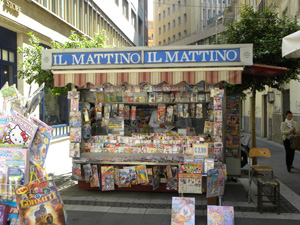
The Odious Women Tour:  The writer Matilde Serao (1856-1927) wrote twenty-nine novels during her liftetime and is best known for having founded the daily Neapolitan newspaper Il Mattino.  The newspaper still is the most widely read daily paper of southern Italy.


At the age of twenty-six, Matilde left Naples to 'conquer Rome'.  There, she wrote everything from literary criticism to gossip.  Her squat figure also managed to get the attention of writer Eduardo Scarfoglio and the two were married in 1885.  Their union was not only romantic, but professional as they established a newspaper together called Corriere di Roma.  The newspaper, however, wasn't successful and landed the couple into serious debt.


Fortunately, the owner of the Neapolitan Corriere del Mattino promised to pay their debts if they came to Naples and wrote for his publication.  Matilde and her husband agreed.  They worked for the Corriere for many years, until their private life went public.   


Eduardo began an affair with a singer and actress and two years later, his mistress became pregnant.  When Eduardo refused to leave Matilda, his lover became so incensed that in 1894 she placed their daughter at Eduardo's door step and fired a pistol.  While the scandal was at first suppressed, eventually the Corriere di Napoli  broke the story.  A week later, Eduardo's lover died in the hospital and Matilda began to take care of the little girl, Paulina.  Although Eduardo and Matilda continued to live together, eventually Matilda couldn't take his philandering and they separated.


Her popularity as a novelist occurred much before this scandal when she wrote Il Ventre di Napoli (1884), a realistic portrayal of life in Naples, which criticized the government for its handling of the cholera epidemic and detailed the appalling living conditions of the poor.

Ardently against feminism and against giving women the right to vote, Serao's early fiction, including Cuore infermo ( 1881 ) and Fantasia ( 1883 ) explored the dissatisfactions with heterosexual relationships and seemed to say that fulfilling relationships could better be found between women.


Matilde Serao died in 1927 at her writing desk of a heart attack.  You can pick up Il Mattino throughout the city and also visit Piazzetta Matilde Serao, located just off Via Toledo next to Umberto Galleria.