Day #1: Downtown Naples
1) Start at Piazza del Plebiscito and walk up the steps behind the Piazza. You'll pass the Industrial Arts Museum. Take a left on any street and then start making your way up to Pizzafalcone where the siren Parthenope was born. Lady Hamilton and her husband also had a villa here.
2) Return to Piazza del Plebiscito and continue to the Teatro San Carlo. You can take a tour of the theater or purchase tickets for a show. The gambling mezzo-soprano Isabella Colbran performed here. You can also search for the bust of her lover, Domenico Barbaja.
3) In the distance you'll see the Castel Nuovo where Queen Joanna I was raised by her grandfather Robert the Wise. Petrach, among others, also stayed in this castle.
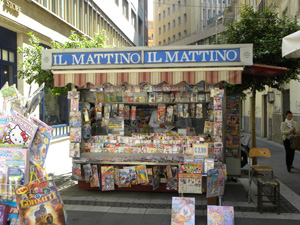
4) Next, head down Via Toledo where you pass Piazzetta di Matilde Serao. Pick up Il Mattino in honor of the journalist, Matilde Serao, who founded the Neapolitan newspaper. Many other palazzos are along this street, including that of Rossini, Isabella Colbran's husband. The Galleria di Palazzo Zevallos Stigliano houses Caravaggio's painting The Martyrdom of Saint Ursula. Artemisia Gentileschi studied under this Baroque painter for a time.
5) From Via Toledo head to Piazza Del Gesu Nuovo and then take a right onto Via Santa Chiara. Here, you can enter the Spanish tiled cloister where the Clarissa Nuns still live today. Search for the remains of Queen Joanna I whose body was dumped somewhere inside.
6) Walk along the bustling Via S. Biagio Dei Librai and take a left on Via Duomo. One block up and to your right, you'll see the Castel Capuano in the distance where Queen Joanna II had her court.
7) Take Via Duomo until you reach the Naples Cathedral. A side chapel here pays tribute to Saint Restituta, the African saint whose remains came to Naples with San Guadioso. This basilica was originally dedicated to her and in the side chapel you can still visit part of the original paleo-Christian basilica.
8) Going down the hill from Via Duomo, you'll reach Piazza Garibaldi. Eusapia Palladino used to give her seances at a hotel here that no longer exists. Nearby, there's an English language cemetery. Eusapia lived and died in an apartment somewhere along the adjacent street.
9) A few blocks from Piazza Garibaldi and a stone's throw from the port, the Piazza Mercato was once known as Execution Square. The Parthenopean Rebel, Eleonora Fonseca Pimental was executed in this space surrounded by three churches. Today, the space is often used as a soccer field.
10) Return to Via Duomo and walk past the Cathedral all the way up to Piazza Cavour. A bus takes you from here to the Museo di Capodimonte where you can search for the works of Artemisia Gentileschi.
11) Head back by bus to Piazza del Plebiscito and walk up Via Chiaia until you reach the Bay of Naples. Mary Shelley purportedly came up with her idea of the character Frankenstein along this promenade. The street is called Parthenope after the siren who lured Ulysses onto the shores. The Castel dell'Ovo is where Joanna I was held captive for a time. Sophia Loren dined at the restaurant La Bersagliera and they have pictures of her inside.
12) Heading along the Bay away from the downtown area, you'll hit Via Posillipo where the Palazzo Donna'Anna has the ghostly legends of Anna Carafa and Queen Joanna II. The opulent villas along this street also have many beaches for swimming and sunbathing during the summer.
Day #2: Caserta -- Torre Annunziata -- Salerno
1) The Reggia di Caserta is where the Bourbons created their Versailles-like court. Queen Maria Sophia lived here and you can see some of her apartments as well as her portrait in the Art Gallery. (The Caserta Palace is also part of my Bourbon Tour.)
2) Head out to Torre Annunziata where you can visit Oplontis, the villa of Roman Emperor Nero's wife, Poppaea.
3) End the day at the Medical School in Salerno, about an hour drive from Oplontis. The physician Trotula worked at this medical school, once considered the best in Europe.
Day #3: The Phlegraean Fields
1) Visit the trapezoidal Antro della Sibilla where the Cumean Sybil uttered her oracles.
2) Make an appointement with Carlo Santillo to see the Grotto della Sibilla, located at Lago Averno where the Cimmerean Sybil gave her oracles.
3) The Tomb of Agrippina in Bacoli has an eerie old theater said to hold the remains of Roman Emperor Nero's mother. There's an Underwater Diving School up the street, restaurants along the water, a Lido, and a promenade for walking.
4) Pozzuoli is a port town with an amphitheater, several archeological ruins, and a wonderful nightlife. St. Paul was said to have landed on these shores one his way to Rome. For the Odious Women Tour, Pozzuoli is the birthplace of the forever elegant actress, Sophia Loren.